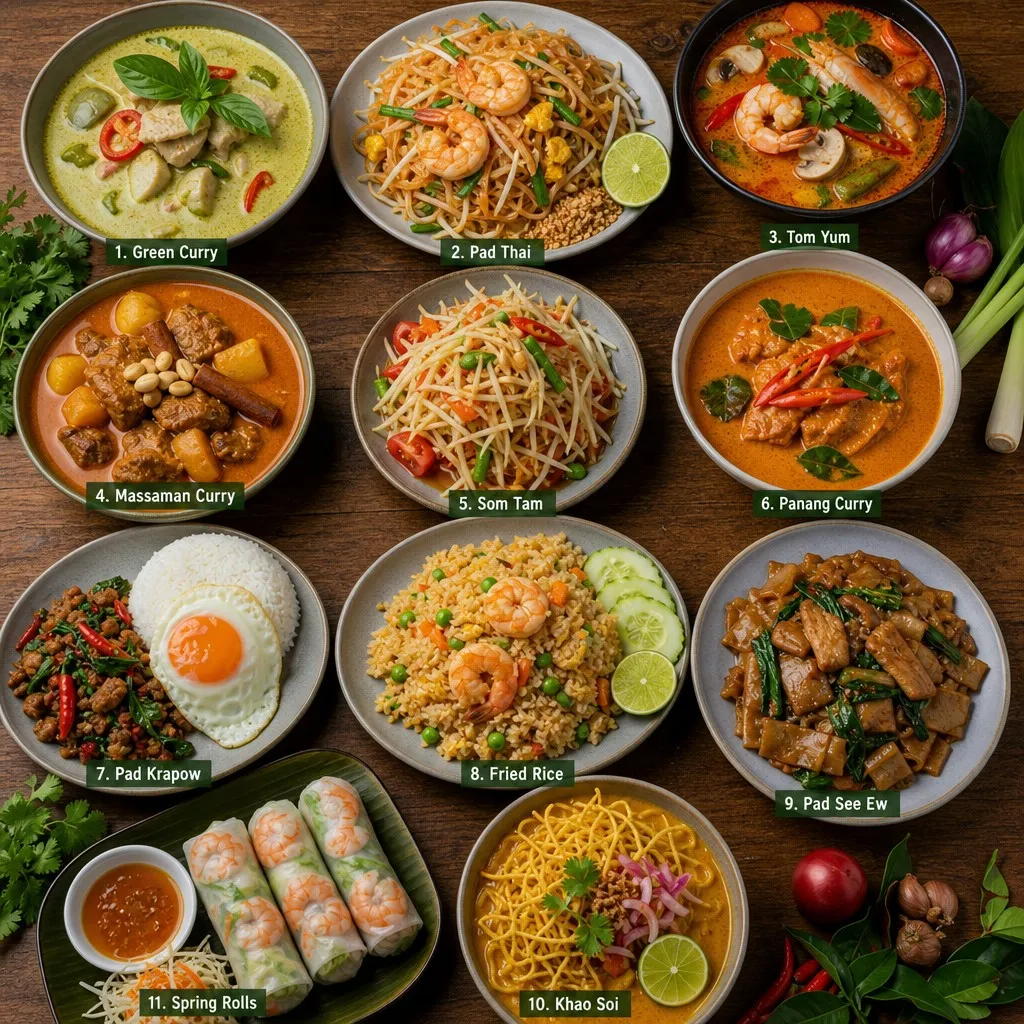
These are the 10 most popular Thai dishes among international visitors, the ones most often highlighted in official Thai food heritage. After two decades of running pop-up events across Dorset, they're the dishes my guests ask about most. I'm Manaow Prasatthong, a third-generation Thai chef, and I've been cooking these recipes since I was old enough to stand at my grandmother's side.
Below I've given each dish the depth it deserves: what it actually tastes like, where it comes from, what to look for in a good version, and how to make it at home. These are the dishes that define Thai cuisine for most of the world, so let's do them justice.
The 10 most popular Thai dishes

1. Green Curry (Kaeng Khiao Wan)
Green Curry (Kaeng Khiao Wan, which literally means "sweet green curry") is a creamy, aromatic dish that many people first encounter at a Thai restaurant and then spend years trying to recreate at home. The vibrant green colour comes entirely from fresh green chillies ground into the curry paste, not from herbs as people sometimes assume.
A proper paste is built on green chillies, lemongrass, galangal, kaffir lime zest, shrimp paste, and garlic. Chicken thighs stay more tender than breast and are the traditional choice, simmered in coconut milk with Thai eggplant and bamboo shoots. Fresh Thai basil goes in at the very end, off the heat.
The flavour should be floral, herby, and moderately spicy: noticeable heat, but never overwhelming the coconut. The sweetness comes naturally from the milk, not added sugar. In my grandmother's kitchen, this was made entirely from scratch. Check out my Thai green curry paste recipe or the full Thai green curry recipe, both from my family. And if you've ever wondered why green curry is actually green, that's a good read too.

2. Pad Thai
Pad Thai is one of the most searched Thai recipes in the world, and it deserves more credit than the sweet, peanut-heavy version most people encounter in Western takeaways. A proper Pad Thai is a more delicate dish than its reputation suggests.
The sauce is tamarind paste, fish sauce, and palm sugar: sour, salty, and sweet in roughly equal proportion, with none dominating. When one of those three dominates, why pad thai tastes too sweet or too sour covers how to correct it. Thin rice noodles are stir-fried quickly over high heat with egg, bean sprouts, and your choice of protein. Prawns and chicken are most common; tofu for vegetarians. The final garnish (lime wedge, crushed roasted peanuts, dried chilli flakes) is not decorative. You mix them in yourself, to taste.
What most people don't know: Pad Thai was essentially invented in the 1940s by the Thai government as part of a nationalist campaign to give the country a single national dish. It worked spectacularly. It's one of the most requested dishes at our Thai catering events in Dorset, and one I'm most careful about. It's easy to make mediocre Pad Thai, and surprisingly hard to make a great one. If yours keeps coming out pale instead of that glossy orange, we've explained exactly why restaurant pad thai is orange.

3. Tom Yum Goong
Tom Yum Goong is Thailand's most famous soup — so celebrated that Thailand has put it forward for UNESCO intangible cultural heritage recognition — and the one most likely to make first-time eaters stop mid-spoon. The aromatic base of lemongrass, galangal, kaffir lime leaves, and bird's eye chillies fills the room before the bowl even reaches the table. It's also the soup Thais reach for when they're under the weather — see whether tom yum is good for a cold.
"Goong" means prawns, though chicken versions (Tom Yum Gai) are just as common. The broth is clear, not cream-based (see the difference between clear and creamy Tom Yum), and hits four notes simultaneously: sour from lime juice, salty from fish sauce, spicy from chilli, and deeply fragrant from the aromatics. The lemongrass stalks, galangal slices, and kaffir lime leaves are left in the bowl as flavouring; they're not meant to be eaten. Move them to the side.
Tom Yum at its best is one of the most complex soups in any Asian cuisine. My easy Tom Yum recipe keeps the technique simple without sacrificing the aromatics that make it what it is.

4. Massaman Curry
Massaman Curry is the mildest of Thailand's major curries and, arguably, the most complex. It originates from the deep south of Thailand, an area with strong Muslim influence, and its spice profile reflects Persian and Malay culinary traditions carried along historical trade routes. You'll taste cinnamon, cardamom, star anise, and clove alongside the usual Thai aromatics.
It's a slow-cooked curry: chunks of beef or lamb simmered for hours with potatoes, peanuts, and onion in a rich coconut milk gravy. The result is fall-apart tender meat and a sauce that's thick, sweet-spiced, and deeply savoury. Pork is traditionally avoided due to the dish's Muslim heritage.
In 2011, CNN's World's 50 Best Foods placed Massaman Curry at number one. For anyone who finds green or red curry too spicy, Massaman is often the best starting point. It's also a dish where the paste varies significantly by region: Southern Thai food has its own version that's more assertive than the central Thai restaurant standard.

5. Som Tum (Green Papaya Salad)
Som Tum is made by pounding shredded unripe papaya in a clay mortar with garlic, chilli, lime juice, fish sauce, palm sugar, and tomatoes. It's the most common street food in Thailand. You'll find vendors on virtually every corner, each with their own heat level and personal variation.
The dish originates from Isaan, the northeast of Thailand. Isaan food is known for being fiery, fermented, and bold, and Som Tum reflects all three. The local version often includes fermented crab (pu pla ra) and fermented fish sauce, giving it a funky depth that tourist-friendly versions tend to omit. What you get in most Thai restaurants abroad is a milder, cleaner version.
The crunch of the papaya, the heat of the chilli, the sourness of the lime, and the saltiness of the fish sauce all compete and balance simultaneously. It's impressive what a mortar and a handful of ingredients can produce.

6. Panang Curry
Panang is the curry that surprises people who expect all Thai curries to be soupy. It's thick, dry, and intensely flavoured: closer to a stir-fry coating than a broth. The paste is built on a red curry base but with roasted peanuts ground directly into it, giving Panang its distinctive nutty richness.
Coconut milk is added in a smaller ratio than green or red curry, so the sauce coats the meat rather than surrounding it. Kaffir lime leaves are shredded finely and stirred through at the end. Beef is the classic protein (Panang Neua), though chicken and pork are common. The flavour is rich, slightly sweet, and nutty, with enough heat to keep it interesting but far less aggressive than green curry.
If you're learning to make Thai curries at home, Panang is actually a good starting point. The thick sauce doesn't split as easily as a green curry broth, so it's more forgiving.
คนไทยอยู่ในอังกฤษใช่ไหม? ลองดูหน้า อาหารไทยในอังกฤษ ของเราสิ!

7. Pad Krapow (Thai basil stir-fry)
Pad Krapow is a stir-fry of minced meat with Thai holy basil, and it's what Thais eat for lunch when they can't decide what they want. It's Thailand's default comfort food: fast, fiery, deeply savoury, and always served with jasmine rice and a fried egg on top.
Can't decide what to eat tonight?
Take our 60-second quiz and we'll pick for you
The ingredient that defines this dish is krapow: Thai holy basil, not the sweet Italian basil or even regular Thai basil. Holy basil has a peppery, slightly clove-like edge that completely changes the character of the dish. When it hits the hot wok, the smell is remarkable. The fried egg (kai dao) on top isn't a garnish. The runny yolk cuts the heat and adds richness that holds the whole dish together.
The heat level in an authentic version is significant: street vendors typically use ten to fifteen bird's eye chillies per portion. Most commonly made with minced pork (moo saap) or minced chicken. At our events in Dorset, the chicken version (Pad Krapow Gai) is always one of the first to go.

8. Khao Pad (Thai fried rice)
Khao Pad is Thai fried rice, and it differs from Chinese fried rice in ways that matter. The rice must be jasmine rice, cooked and left to cool so the grains separate cleanly. Fresh rice is too wet and clumps or goes mushy. The seasoning is fish sauce and Thai seasoning sauce rather than soy sauce, giving it a more savoury, slightly fermented character.
Common proteins are chicken, prawns, or crab. Crab fried rice (Khao Pad Pu) is the premium version and genuinely exceptional when made with fresh crab. Egg is mixed through during cooking, not laid on top. The accompaniments are important: a wedge of lime, sliced spring onion, cucumber wedges, and a small bowl of prik nam pla (fish sauce with sliced chillies) served alongside.
A properly made Khao Pad (high heat, fast cook, well-rested rice) is one of the most satisfying things in Thai cooking. It's also one of the best meals to order when you want something straightforward done well.

9. Pad See Ew
Pad See Ew uses wide flat rice noodles (sen yai) stir-fried over extremely high heat with dark sweet soy sauce, egg, Chinese broccoli, and your choice of protein. It's the noodle dish for people who prefer something with more body and caramelised depth than Pad Thai.
The key to a good Pad See Ew is wok hei, the "breath of the wok": a slightly smoky, charred quality that comes from cooking at very high heat in a well-seasoned wok. Home cooks struggle to replicate this because domestic hobs don't get hot enough. It's worth ordering at a restaurant specifically to understand what proper wok hei does to a dish. If your noodles keep clumping or the sauce won't coat them at home, our cooking troubleshooting guides explain why.
The flavour is savoury, slightly sweet from the dark soy, and smoky. It's one of the least spicy dishes on this list: no chillies in the cooking, though dried chilli flakes come on the side. If you enjoy drunken noodles (Pad Kee Mao), think of Pad See Ew as its calmer, slightly sweeter sibling.

10. Khao Soi
Khao Soi is the dish that makes people fall in love with Northern Thai food. It's a coconut curry noodle soup that layers two textures of egg noodle in the same bowl: soft noodles braised inside the broth, and crispy deep-fried noodles on top. The broth is rich, aromatic, and gently spiced, with influences from Burmese and Yunnan Chinese cuisines carried along the old trade routes through Chiang Mai.
The garnish is as important as the soup: pickled mustard greens, shallots, lime, and a spoonful of chilli oil are served on the side and added to taste. Each spoonful changes slightly depending on how much you've stirred in. It's an interactive bowl of food in a way that most soups aren't.
Khao Soi is to Chiang Mai what Pad Thai is to Bangkok. It's rarer in central Thailand and relatively hard to find in the UK, which is why it tends to genuinely surprise people when they try it for the first time. The flavour profile is unlike anything else on this list: warmly spiced with turmeric, dried chilli, and curry powder, deeply savoury, and creamy without being heavy.
Ready to explore further?
These ten dishes are the entry point, not the full picture. Once you've worked through the classics, the real exploration begins: the fermented, fiery cooking of Isaan, the herb-heavy cuisine of the north, and the coconut and seafood-rich dishes of the south.
If you want to cook Thai food at home, my easy Thai recipes with chicken are a good place to start: straightforward dishes that don't require specialist equipment. The full Thai recipe collection has plenty more. And if you've wondered whether all this food is actually good for you, I've written a detailed breakdown of whether Thai food is healthy.
You might also enjoy the 5 most popular Thai street foods: a different list with some overlap, and a few surprises.
Sources
Thai food heritage and popularity: Thailand Foundation (Thai Food); Thailand NOW (UNESCO tom yum kung recognition).



Comments