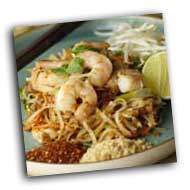
It's one of the most common questions I get: the pad thai at your local Thai place comes out a glossy orange-red, but yours turns out pale, beige or a bit brown, even when you follow the recipe. The short answer is that the colour comes from a few specific things working together: dried chilli powder, tamarind and palm sugar caramelising over fierce heat, and a proper coating of sauce. And, to be honest, some restaurants give it a nudge with paprika, ketchup or even a little food colouring.
Here's exactly what's going on, and how to get that warm orange colour at home: the authentic way.
The quick answer
Restaurant pad thai is orange mostly because of Thai dried chilli powder (prik bon) stirred through the dish, plus tamarind and palm sugar caramelising at high wok heat, which turns the sauce a deep reddish-amber that coats every strand. Pale homemade pad thai usually means too little chilli, too little sauce, or a pan that isn't hot enough to caramelise it. Some Western restaurants also add paprika, ketchup or sriracha for a brighter (less authentic) orange.

Reason 1: Dried chilli powder (prik bon)
This is the big one. Thai cooks stir a spoonful of toasted dried red chilli powder (prik bon) through the noodles, and it's almost always on the table to add at the end. That red chilli, suspended in the oil and sauce, tints the whole dish orange. It's not necessarily about heat; even a modest amount shifts the colour dramatically.
If your pad thai is pale, the simplest fix is a teaspoon of Thai chilli powder (or a mild Korean/Kashmiri chilli if you want colour without much burn) added with the sauce. Smoked or sweet paprika does a similar job for colour alone.
Reason 2: Tamarind and palm sugar caramelising over high heat
Proper pad thai sauce is tamarind, fish sauce and palm sugar. When that hits a screaming-hot wok, the sugars caramelise and the tamarind darkens to a glossy reddish-amber, and that colour transfers straight onto the noodles. This is the same reason street-stall pad thai looks richer than home versions: vendors cook over roaring heat that home hobs can't match.
On a weaker home hob the sauce tends to stew rather than caramelise, so it stays pale and watery-looking. Get the pan as hot as you can, cook one or two portions at a time, and let the sauce reduce and catch slightly rather than simmer. (If your noodles are clumping together while you do this, cook in smaller batches and make sure the pan is properly hot before adding anything. And if the extra sauce and heat leave it greasy rather than glossy, that's a separate fix.)
It's worth being clear about what "caramelising" actually means here, because two different reactions are doing the work. Caramelisation is the palm sugar itself browning, which needs real heat: below a certain temperature the sugar just dissolves and stays pale. The Maillard reaction is the browning between the sugars and the proteins in the fish sauce and dried shrimp, and it's what gives the dish its savoury, toasty depth as well as colour. Both only kick in properly when the pan is genuinely hot, which is exactly why a gentle simmer never gets you there.
Why your home hob can't keep up (the BTU gap)
Our Thai Black Pepper Beef Stir Fry gets a similar glossy finish with less oil, which is the key difference between restaurant and home versions. It's not about colour at all, it's about heat.
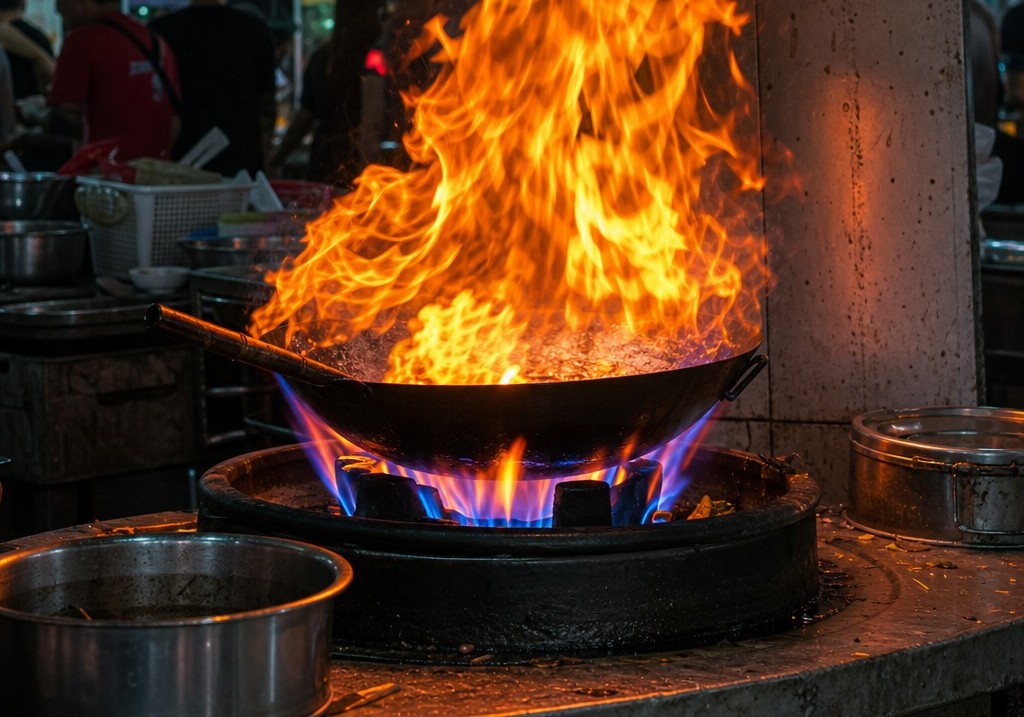
This is the part most explanations skip, and it's the real reason restaurant pad thai looks different. It comes down to raw power. A Thai street vendor's wok burner puts out somewhere around 100,000 to 200,000 BTU. A typical home gas hob manages perhaps 7,000 to 12,000 BTU, and an electric or induction hob less still. That's not a small gap; the restaurant burner is roughly ten to twenty times more powerful.
That heat is what flash-caramelises the sauce in seconds before the noodles have a chance to sit and steam. At home you simply can't hit those temperatures, so the same sauce browns more slowly and shallowly, which reads as a paler plate. You can't fully close the gap in a domestic kitchen, but you can narrow it: use your most powerful burner, a thin carbon-steel wok or wide pan that heats fast, preheat it until it's smoking, and cook small batches so the pan temperature doesn't crash when the food goes in. Knowing this also takes the pressure off. If your pad thai is a shade paler than the restaurant's, your hob is a big part of the reason, not your skill.
Reason 3: Enough sauce, properly coating the noodles
Colour is partly about coverage. Restaurants use a confident amount of sauce and toss hard so every strand is glazed. Timid home cooks often under-sauce, so the noodles stay the pale colour of plain rice noodles with a few darker patches. A well-seasoned, well-tossed plate simply looks more orange because there's coloured sauce on every strand.
Can't decide what to eat tonight?
Take our 60-second quiz and we'll pick for you
Reason 4: The shortcuts: paprika, ketchup, sriracha
Here's the honest bit. That very bright, almost neon orange you sometimes see (especially at busy or Westernised places) often isn't pure tamarind and chilli. Many restaurants add a squeeze of ketchup, tomato paste or sriracha to the sauce. It's quick, cheap, sweet and gives a reliable bright orange-red every time. It's not traditional, but it's extremely common outside Thailand.
So if you've been chasing a colour that bright at home with only tamarind, that's why you can't quite get there: the restaurant may be using tomato. You can do the same with a teaspoon of ketchup if you like that style, but it will taste sweeter and more Western than authentic pad thai.
Reason 5: Annatto or food colouring (sometimes)
A few places, particularly for buffets and photos, use annatto (achiote) oil or a drop of orange food colouring to guarantee a vivid, consistent colour. It's purely cosmetic. You don't need it, and authentic pad thai never relies on it; it does explain some of the most uniformly orange plates you'll see.
So why is mine pale or brown?
If your pad thai keeps coming out the wrong colour, it's almost always one of these causes. No chilli powder is the most common: without prik bon or paprika there's little to make it orange, so it stays beige. Too little sauce is the next culprit; under-sauced noodles look pale and patchy, so be more generous and toss thoroughly. A pan that isn't hot enough is equally important: a cool pan stews the sauce instead of caramelising it, so it never develops that glossy amber tone. Leaning on soy sauce is another trap: a small amount of dark soy adds colour, but using it in place of tamarind pushes the dish brown and muddy rather than orange. Pad thai should rest on tamarind and fish sauce, with soy as a minor player at most. Finally, old or watery tamarind gives a thin, pale sauce; use a good tamarind concentrate or paste.
How to get the colour at home: the authentic way
- Make a proper sauce: tamarind concentrate, fish sauce and palm sugar, roughly equal parts, adjusted to taste.
- Stir in ½–1 tsp Thai dried chilli powder (or sweet/smoked paprika for colour without heat).
- Get your wok genuinely hot and cook just one or two portions at a time.
- Add the sauce in one go and let it caramelise and reduce; don't let it sit and simmer.
- Toss hard so every strand is coated. Finish with crushed roasted peanuts and a wedge of lime.
A chef's tip the recipe blogs miss: a teaspoon of nam prik pao (Thai roasted chilli jam) stirred into the sauce is a genuinely authentic way to deepen both colour and flavour. It's made from roasted dried chillies, shallots, garlic, dried shrimp and tamarind, so it's naturally a deep orange-red and adds a smoky, slightly sweet richness without tasting of tomato. It's how I add colour and roundness at the same time, and it's far closer to the real thing than reaching for ketchup.
Get those right and you'll have a pad thai with that warm, restaurant-style colour: an honest, tamarind-led flavour rather than a ketchup-sweet one.
A note on what colour pad thai should be
For the record: authentic Thai pad thai is a warm amber-orange to reddish-brown, not a bright traffic-cone orange. That deep, natural colour comes from tamarind, palm sugar, fish sauce, dried shrimp and a little chilli, not from tomato or dye. So if your homemade version is a rich amber rather than neon, you're actually closer to the real thing than the restaurant down the road.
Frequently asked questions
What actually makes pad thai orange?
Mostly Thai dried chilli powder (prik bon) stirred through the dish, plus tamarind and palm sugar caramelising over high heat into a glossy reddish-amber sauce that coats the noodles. Some restaurants also add paprika, ketchup or sriracha for a brighter orange.
Do Thai restaurants use ketchup in pad thai?
Many Western and budget restaurants do. A little ketchup, tomato paste or sriracha gives a reliable bright orange-red and extra sweetness. It isn't traditional; authentic pad thai gets its colour from tamarind, chilli and caramelised palm sugar, not tomato.
Is authentic pad thai supposed to be bright orange?
No. Real Thai pad thai is a warm amber-orange to reddish-brown, not neon. A very vivid, uniform orange usually means added tomato, paprika or food colouring. A rich amber colour is actually closer to authentic.
How do I make my pad thai more orange at home?
Stir ½–1 tsp Thai dried chilli powder (or sweet/smoked paprika for colour without heat) into the sauce, use enough tamarind-based sauce to coat every strand, and cook over high heat so the sugars caramelise. For a Western-style bright orange, add a teaspoon of ketchup.
Why is my pad thai brown instead of orange?
Usually too much dark soy sauce, which muddies the colour. Pad thai should lean on tamarind and fish sauce rather than soy. Weak or old tamarind and a pan that's too cool to caramelise the sugar also leave it dull and brown.
What is prik bon?
Prik bon is Thai toasted dried red chilli powder. A spoonful stirred through pad thai (or sprinkled on at the table) is the main reason restaurant versions look orange, and it's a standard Thai condiment.
Does a more orange colour mean the pad thai is spicier?
Not necessarily. Colour can come from mild paprika, tomato or food colouring with little heat, while a paler plate can still be fiery. Chilli powder adds both colour and heat, but they don't always go together.
Why does street-stall pad thai look richer than mine?
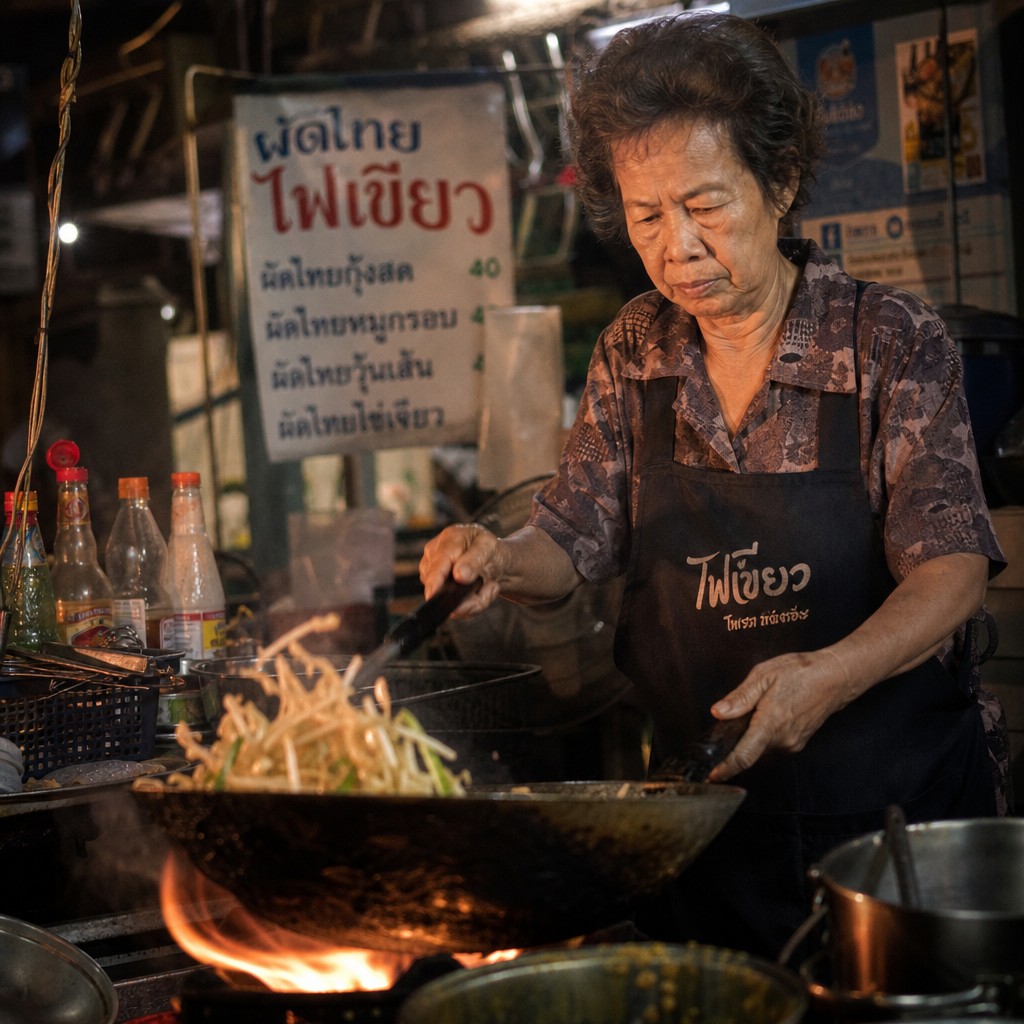
Street vendors cook over ferocious heat (roughly 100,000–200,000 BTU versus 7,000–12,000 on a home hob), which caramelises the tamarind and palm sugar in seconds, deepening the colour. They also sauce and toss generously. On a weaker home hob the sauce stews pale instead of caramelising.
Can I get the orange colour without using ketchup?
Yes, and more authentically. Use Thai dried chilli powder or a little sweet/smoked paprika for colour, and stir in a teaspoon of nam prik pao (Thai roasted chilli jam) for a natural deep orange-red plus extra depth. Cook over high heat so the tamarind and palm sugar caramelise.



Comments