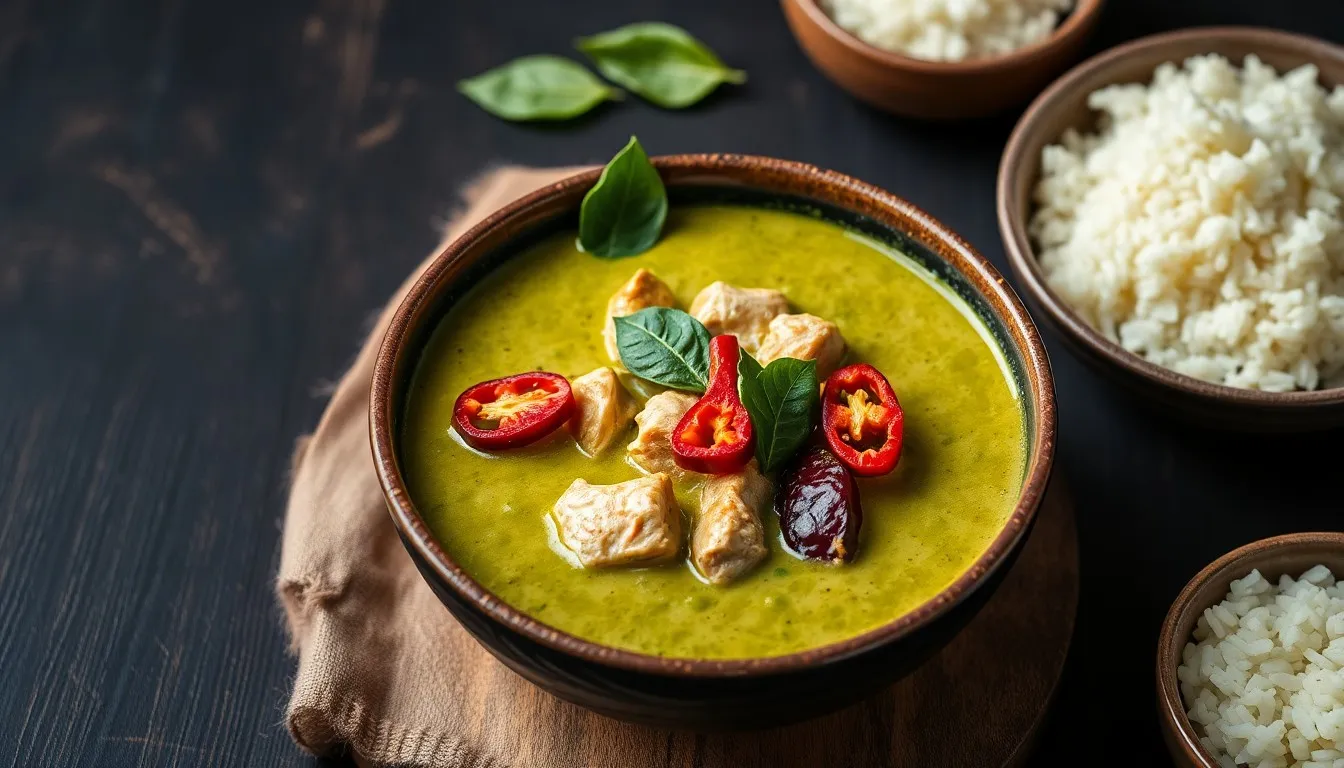
This is my personal Thai Green Curry recipe that has been in my family for a very long time. My grandparents were actually some of the first people to introduce green curry to the north of Thailand. Northern Thai food is very different from regular Thai food and back in the 1950’s people had never seen a green curry before!! My grandparent’s Thai green curry recipe soon became very popular in and around Chiang Mai — and it’s the same recipe I cook as part of our authentic Thai catering in Dorset.
Nowadays Thai green curry is the most famous of all Thai curries and is popular all around the world. Although it’s not extremely hot it certainly has a kick to it! This is because Thai green curry paste is actually green because of the green chillies which is one of the main ingredients in the curry paste. The greener the curry the hotter it’s going to be! If you want a plant-based version, try my vegan Thai green curry recipe.
You can have a go at making your own green curry paste if you want. It’s not hard but finding the right ingredients can be tricky. There are plenty of online shops that stock Thai ingredients, from curry pastes and premium coconut milk to fish sauce and fresh herbs. A quick search for "Thai ingredients UK" will turn up several reliable suppliers that deliver across the country.
Check out my Thai green curry paste recipe if you’re interested. I also recommend the best green curry paste to buy if you don’t want to make your own.

What About The Coconut Milk?
This is really important. This is where your curry can go completely wrong if you choose the wrong coconut milk. The main thing I hear from people is that they can’t get their curry thick and creamy enough. This is simply because they are using poor-quality coconut milk.
In Thailand it’s easy. You can just head down to the market and get a bag of freshly squeezed coconut milk! In Western countries, people just tend to pick up whatever they find in the supermarket. There is quite a wide selection but most of them are just too watery.
You need to head to your closest Asian supermarket or buy some real coconut milk online. There are only 2 brands of coconut milk that I can recommend. My first choice is ChaoKoh Coconut Milk. If that is unavailable then my second choice is Aroy-D Coconut Milk. If your sauce is still too thin even with good coconut milk, my guide on how to thicken curry without flour or cornflour covers several other fixes.

My family’s recipe: This is the same green curry my grandparents cooked when they helped introduce green curry to northern Thailand in the 1950s, and it’s the version I make for our catering events across Dorset. The one thing that matters: simmer the curry paste in the coconut milk for at least five minutes before anything else goes in — it’s the single biggest difference between a fragrant curry and a bland one.
Thai Green Curry
Ingredients
- 400 ml Coconut Milk
- 2 tbsp Green Curry Paste
- 300 g Sliced Chicken Breast
- 3 tbsp Fish Sauce
- 50 g Palm Sugar
- 50 g Sliced Aubergine
- 50 g Sliced Green Pepper
- 50 g Sliced Courgettes
- 30 g Mange Tout
- 3 Kaffir Lime Leaves
- 3 Basil Leaves
- 1 Long Red Chilli
- 1 sprig Basil
Instructions
- Put a quarter of the can of coconut milk in the sauce pan or wok and let it simmer for a couple of minutes
- Add your curry paste and stir it into the coconut milk until it’s all mixed together.
- Let it simmer for at least 5 minutes until it becomes fragrant. The longer you leave it simmering the more flavoursome your curry will be! (This is the most important part of the recipe and many green curries end up tasting terrible because the curry paste isn’t left to simmer for long enough).
- Add the chicken and stir it into the curry paste until all the chicken is covered.
- Add the remainder of the coconut milk and turn the heat up and bring it to the boil before reducing the heat again to let it simmer.
- Add the sugar and fish sauce.
- Stir and then taste. (You can add more sugar or more fish sauce if the flavour isn’t strong enough).
- Add the aubergine first (as these take longer to cook)
- When it begins to boil again you can add the courgettes, baby corn and kaffir lime leaves.
- Bring it to the boil once more and that’s it.
- Spoon it into a serving bowl and sprinkle with the basil leaves and chilli slices.
Video
Notes
- Use less curry paste if you don’t want it too spicy
- You can use normal white sugar if you don’t have palm sugar
- You can use different vegetables if you want (but try and keep the total to 250g)
- Use white sugar if you can’t find any palm sugar
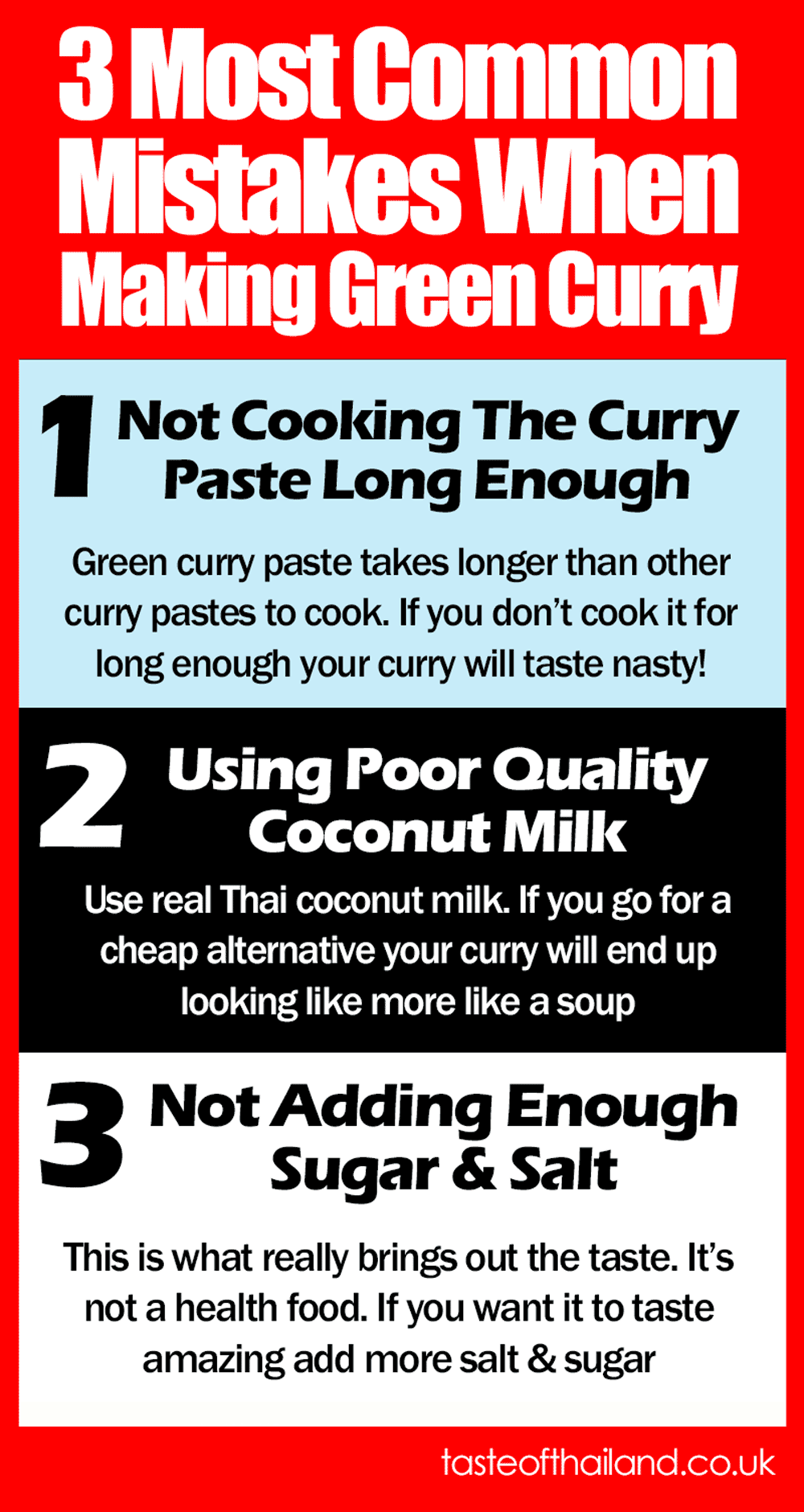

What Goes in Thai Green Curry? The Key Ingredients

People are often surprised by how few ingredients a real green curry needs. The magic sits in the green curry paste, which carries all the aromatics, so the curry itself is mostly about balancing that paste with good coconut milk and seasoning. Here is what each part does:
- Green curry paste — the heart of the dish: a pounded blend of green bird’s eye chillies, lemongrass, galangal, garlic, shallots, coriander root, kaffir lime and shrimp paste. The green chillies are what make the curry green.
- Coconut milk — use a thick, full-fat brand such as ChaoKoh or Aroy-D. This is the single biggest factor in whether your curry turns out rich or watery.
- Chicken — sliced breast or thigh. Thigh stays juicier, but breast is what most Thai cooks use for this dish.
- Fish sauce & palm sugar — the salty and the sweet that balance the heat. Season to taste right at the end.
- Thai aubergine, courgette & mange tout — the traditional vegetables. Pea aubergines and Thai apple aubergines are the most authentic if you can find them.
- Kaffir lime leaves & Thai basil — torn in near the end for that unmistakable Thai fragrance.
คนไทยตัวจริงหรือเปล่า? ลองดูหน้า อาหารไทยในอังกฤษ ของเราสิ!
How to Get a Thick, Creamy Green Curry Sauce
The most common complaint I hear is that the sauce came out thin and watery — and it is almost always the coconut milk. “Cracking” the first quarter of the coconut milk with the paste — simmering it until the oil splits and it smells fragrant — is what builds a glossy, thick base. Don’t tip all the liquid in at once, and don’t let it boil hard for long, or the coconut milk will separate. If you want it richer still, finish with a couple of spoonfuls of the thick coconut cream from the top of the tin.
What to Serve With Thai Green Curry
Green curry is almost always served with plain steamed jasmine rice — the rice soaks up the sauce and tempers the heat. For a proper spread, serve it alongside other Thai dishes so the whole table shares everything at once, the way we eat in Thailand. It’s also lovely with roti for scooping. A fresh, sharp green papaya salad or a clear soup on the side balances the richness of the curry nicely. A quick stir-fried cabbage is the other half of it: pad galampli takes two minutes and needs nothing but garlic, fish sauce and a very hot wok.

Frequently Asked Questions
What ingredients do you need for Thai green curry?
The core ingredients are coconut milk, green curry paste, chicken, fish sauce, palm sugar, aubergine, courgette, kaffir lime leaves and Thai basil. The quality of the coconut milk makes the biggest difference — use a full-fat brand from an Asian supermarket rather than a watery supermarket own-label version. I recommend ChaoKoh or Aroy-D.
How do you make Thai green curry from scratch?
Start by simmering a quarter of the coconut milk, then add the green curry paste and let it cook for at least 5 minutes until fragrant — this is the most important step and the one most people rush. Then add the chicken, remaining coconut milk, vegetables and season with fish sauce and palm sugar to taste. The full method is in the recipe card above.
What makes Thai green curry authentic?
Three things: good-quality coconut milk, properly cooked paste (don't rush it), and the right balance of salty, sweet and heat. An authentic Thai green curry should be rich and creamy, not watery or starchy. This recipe has been in my family for generations and uses the same method my grandparents used in Chiang Mai.
Why is Thai green curry green?
Thai green curry gets its colour from the green chillies in the green curry paste. The greener and fresher the paste, the more vibrant the colour — and generally the hotter the curry. If you're curious, I explain this in detail in why is green curry green.
Can I use shop-bought paste for Thai green curry?
Yes — a good Thai brand paste works well and is what most people use at home. Avoid supermarket own-label versions. If you want to make your own from scratch, my Thai green curry paste recipe walks you through it with all the ingredients you need.
Can you freeze Thai green curry?
Yes — Thai green curry freezes well for up to 3 months. Cool it completely before freezing and use thick freezer bags rather than plastic containers (the curry will stain them). The coconut milk may separate slightly when reheated — reheat slowly on the hob over a low heat rather than in a microwave, stirring gently, and the sauce will come back together.
Is Thai green curry vegan?
Traditional Thai green curry is not vegan — it contains fish sauce, and most curry pastes include shrimp paste. To make it vegan, use a vegan curry paste (Waitrose stocks one), replace the fish sauce with vegan fish sauce or coconut aminos, and use vegetables or tofu instead of chicken. My vegan Thai green curry recipe walks through the full method.
How long does Thai green curry last in the fridge?
Leftover Thai green curry keeps for up to 3 days in an airtight container in the fridge. Reheat it thoroughly before serving. The coconut milk may separate slightly on standing — this is normal, just stir it back together as it heats.
Why is my Thai green curry watery?
A watery green curry is almost always down to thin coconut milk. Use a thick, full-fat brand such as ChaoKoh or Aroy-D, crack the first quarter of the coconut milk with the curry paste until the oil splits, and avoid boiling it hard for too long, which makes the coconut milk separate.
What do you serve with Thai green curry?
Thai green curry is traditionally served with plain steamed jasmine rice, which soaks up the sauce and balances the heat. It also pairs well with roti for scooping, and works as part of a shared Thai meal alongside a sharp green papaya salad or a clear soup.




Comments