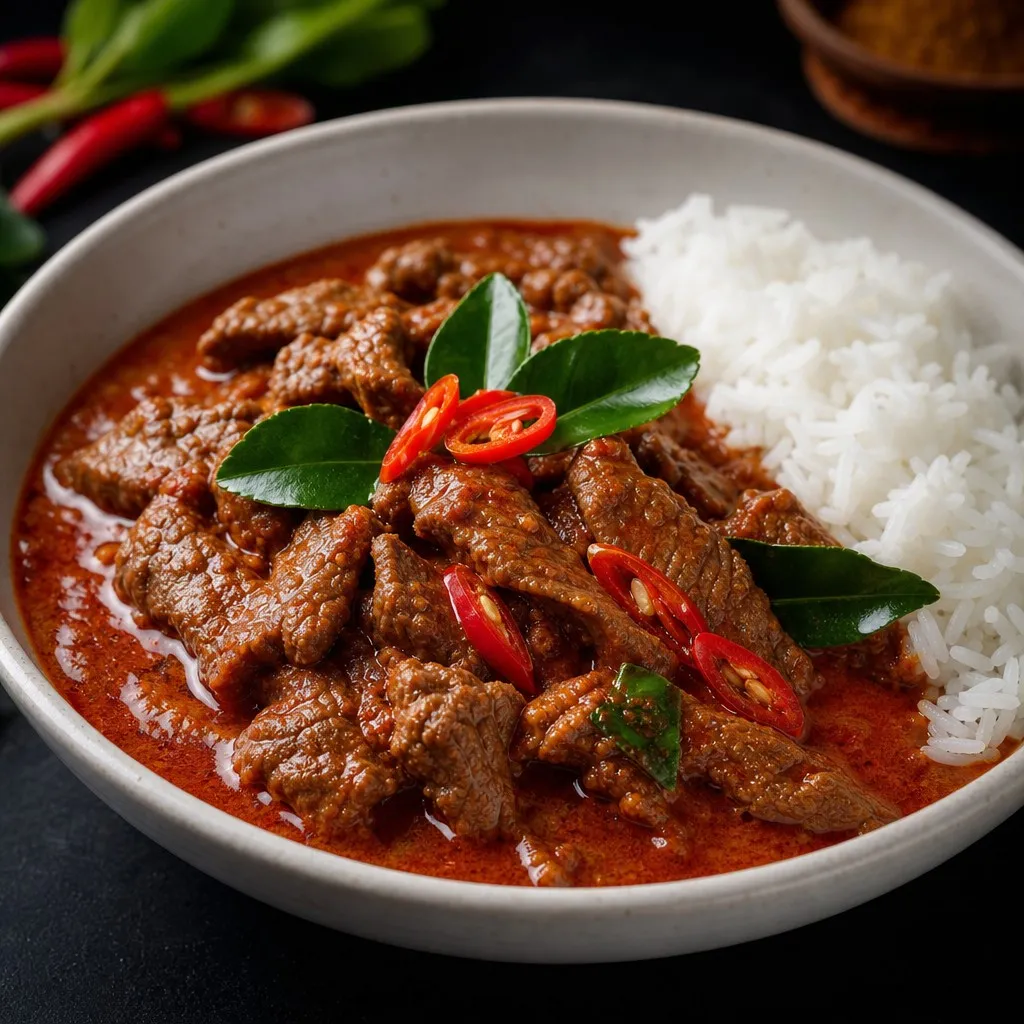
Panang curry is one of Thailand's most beloved curries, and when you taste it for the first time you'll understand why. It's richer and thicker than a standard red curry, a little sweeter, with a nutty depth from the ground peanuts. It's the kind of curry that makes people go quiet when they eat it, in the best possible way.
Beef is the classic choice for Panang. You want a cut that's tender enough to slice thin, and sirloin or rump works beautifully. Cut against the grain so the beef stays tender rather than chewy. Don't rush it, either. A gentle simmer for 10 to 15 minutes lets the beef really absorb the curry sauce.
The kaffir lime leaves are important here too. Most of the leaves go in during cooking, but I always save a few to shred finely and scatter over the top when serving. They bring a bright, citrusy lift that cuts through all that richness perfectly.
What Does "Panang" Actually Mean?
The Thai spelling is พะแนง, pronounced roughly "pha-naeng", though in everyday speech it often comes out closer to "pa-nang". Growing up in Chiang Mai I just called it what it was; the spelling question only arrived when I started writing about it. In English you'll see Panang, Phanaeng, Panaeng, and Panaing, all describing the same dish. Panang has become the standard on UK menus and in cookbooks, so that's what most people recognise, but none of the variants is wrong.
Where the name comes from is genuinely debated. The popular theory links it to Penang in Malaysia, a tidy story about trade routes bringing the curry north. Thai culinary historians are sceptical, though. The earliest known written recipe appears in a Thai cookbook from 1890, and the dish seems thoroughly rooted in central Thai cooking. A more convincing theory traces พะแนง to a Malay word meaning "grilled": the original Panang wasn't a coconut curry at all, but a dry preparation where the protein was basted with spiced paste and cooked over direct heat. The thick, coconut-cream curry we know today is a later and much more popular evolution.
That history of paste pressed close to meat still feels present in the way Panang sauce clings to the beef rather than pooling loosely in the bowl the way a thinner curry does. It's not accidental. It's built in.
 Print
Print
Beef Panang Curry
Ingredients
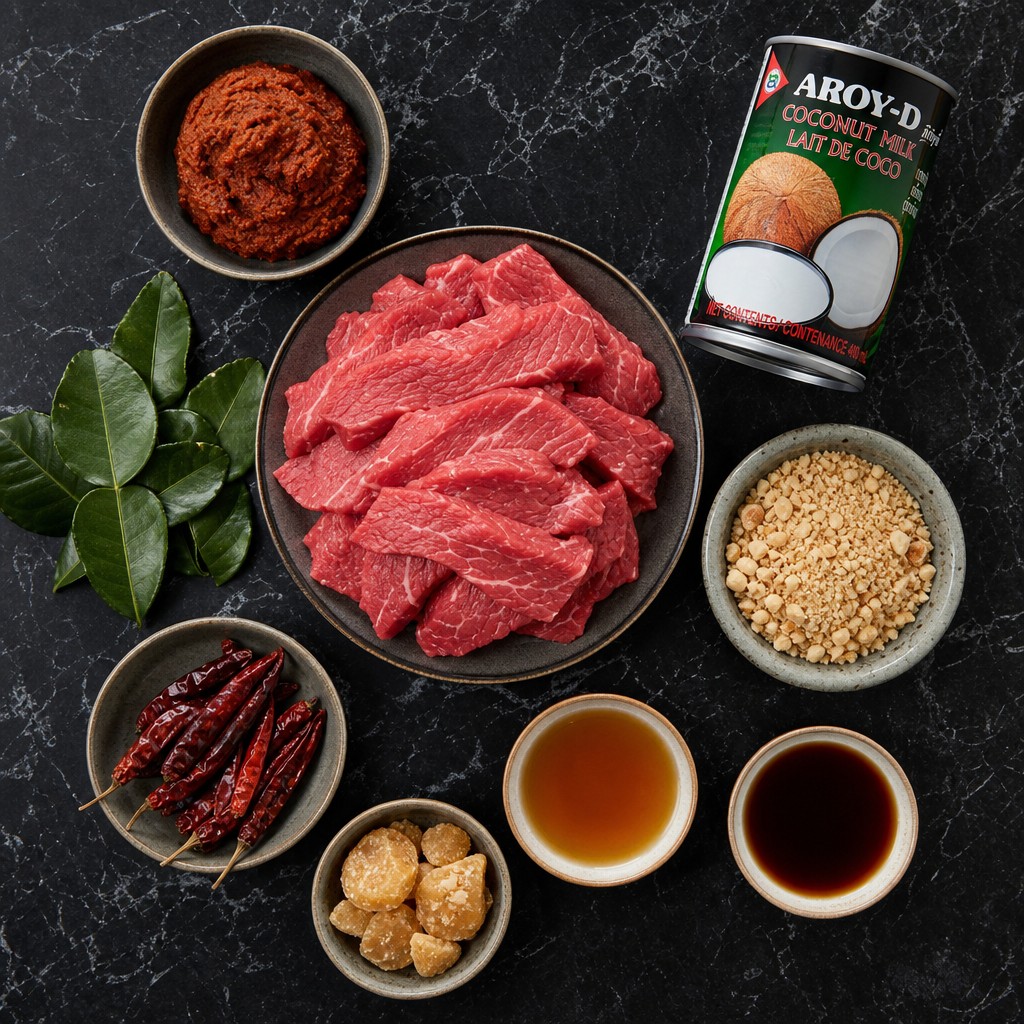
- 300g beef sirloin or rump, thinly sliced
- 2 tbsp Panang curry paste
- 400ml coconut milk
- 4 kaffir lime leaves, shredded
- 1 tbsp fish sauce
- 1 tsp palm sugar
- 2 tbsp roasted peanuts, ground
- 1 red chilli, sliced (to garnish)
- Cooking oil
Instructions
- Heat a little oil in your wok over medium-high heat and add the Panang curry paste. Fry it for a minute or two; you want it hot and fragrant before anything else goes in. This is what builds the base of the flavour.
- Add half the coconut milk and stir to combine with the paste. Let this cook for a couple of minutes to reduce slightly and intensify. You'll see the sauce start to look glossy and smell incredible.
- Add the beef and stir-fry until it's browned all over. Then pour in the rest of the coconut milk, add the fish sauce and palm sugar, and stir everything together. Drop in most of the kaffir lime leaves at this point.
- Turn the heat down to a gentle simmer and leave it for 10 to 15 minutes. The sauce will thicken up and the beef will become really tender. Stir in the ground peanuts near the end, since they add body and that signature Panang flavour.
- Serve over jasmine rice and garnish with the remaining shredded kaffir lime leaves and sliced red chilli.
How to Make Beef Panang Curry
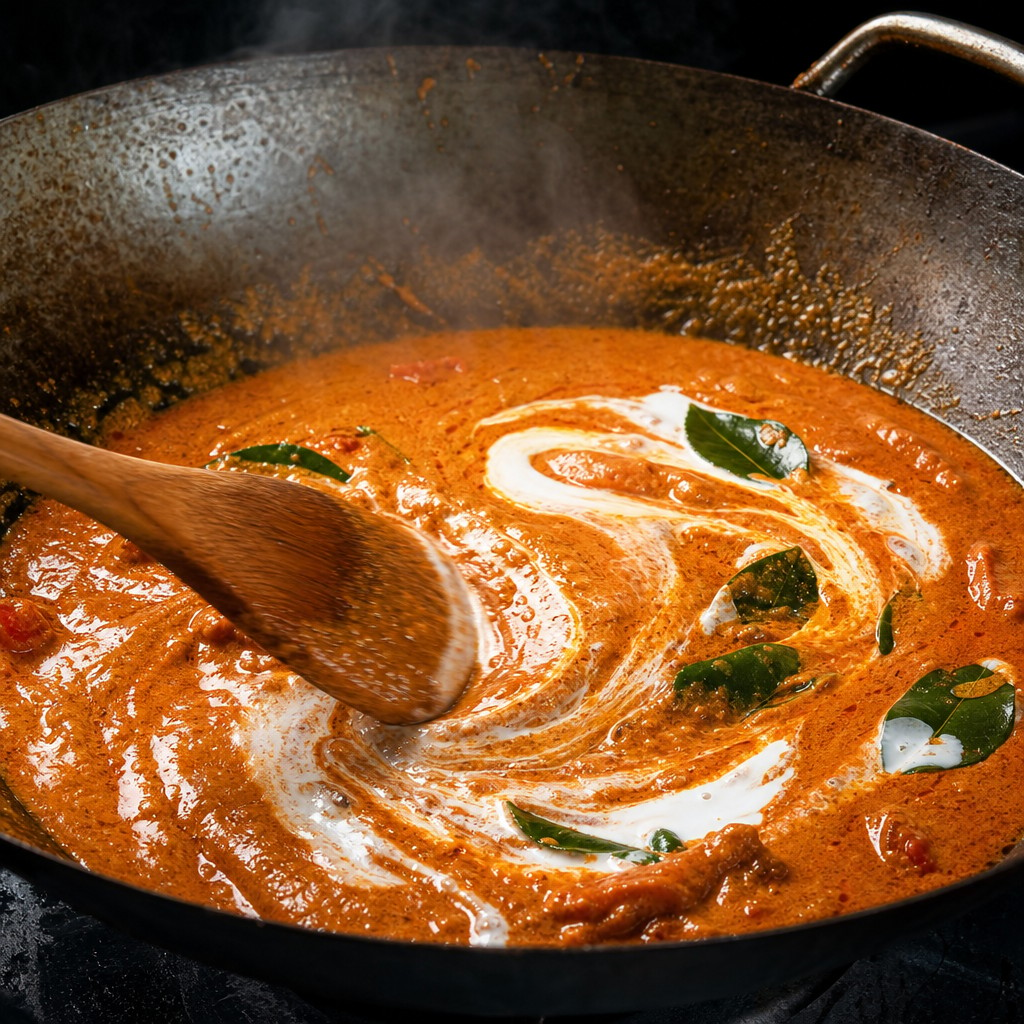
The most important moment happens before any liquid touches the wok. Once the thick coconut cream is in with the paste, watch for the oil to separate from the solids. That's the water evaporating, and it's your signal that the spices are properly blooming. The mixture darkens slightly, smells toasted rather than raw, and you'll see clear oil pooling at the edges. That's when the beef goes in.
Lay the sliced beef in as flat as you can and leave it untouched for thirty seconds. That brief contact with the hot paste builds a sear, the colour and depth that disappears if you move it straight away. Once you add the rest of the coconut milk and turn the heat down, the sauce should blip gently at the surface. A rolling boil breaks the coconut cream and makes the sauce separate and grainy.
Kaffir lime leaves work harder if you shred them rather than leaving them whole. Stack three or four, roll them into a tight cigar, and slice across into fine threads, then run the knife through once more to break up any long strands. Leaves added during cooking give fragrance to the whole pot; finely shredded leaves scattered at the end give a sharp, citrusy hit that cuts through the richness. I do both. Our page on kaffir lime leaves covers dried substitutes if you can't find fresh.
The Coconut Cream Secret
Most recipes tell you to pour the whole tin of coconut milk into the paste and get going. That produces a perfectly decent curry. But there's a technique that changes everything, and once you know it you won't go back.
Don't shake the tin. Set it aside unopened and let the thick cream float to the top, then open it carefully. Spoon just that thick cream, not the liquid underneath, into a dry wok over medium heat and cook it for three to five minutes. What you're watching for is the water to evaporate, leaving clear coconut oil pooling on the surface. That's your moment: add the curry paste straight into that oil and fry it for one to two minutes. The spices bloom in fat in a way they simply can't in liquid. The paste goes fragrant and glossy, the raw edge disappears, and what you end up with tastes like it took far more effort than it did.
Then pour in the remaining liquid from the tin and add the beef, and the sauce that forms around everything is richer and more integrated. It clings to the meat rather than sitting loosely around it. My guide to thickening Thai curries explains the same principle in more detail. It's one of the most useful things to understand about cooking Thai food at home.
What Cut of Beef Works Best
For this recipe, a 15 to 20 minute cook, sirloin or rump sliced thin is the right choice. They're naturally tender, and sliced against the grain they stay that way through the simmer. Cutting against the grain is not optional: go with it and the beef will feel chewy no matter how long it cooks; cut across it and it pulls apart gently the way it should.
If you find thin-slicing fiddly, put the beef in the freezer for 15 minutes first. It firms up just enough to slice cleanly without being frozen solid, and you get consistently thin pieces without much effort. For cheaper cuts, braising steak for instance, a quick velveting step makes a real difference: toss the slices in a little bicarbonate of soda (about ¾ tsp per 300g), leave for 15 minutes, then rinse well and pat dry before cooking. The texture of more economical beef noticeably improves, and it's under a minute of actual work.
If you have more time, short rib or chuck work beautifully. They need an hour or more of gentle simmering to become properly tender, but the fat that renders out adds real richness to the sauce. Either way, a quick sear in a very hot wok before the coconut sauce goes in is worth doing. It adds depth of flavour and colour that you can taste in the finished dish.
Panang vs Red Curry: What's the Difference?
They look similar on the menu and the pastes are close relatives, but they eat very differently. Red curry is soupier, served with plenty of sauce for spooning over rice. Panang is thicker and richer, with far less liquid and ground peanuts worked into the paste that give it a nutty sweetness red curry doesn't have. Panang is also notably milder. If red curry is a bowl of sauce with meat in it, Panang is meat wearing a thick coat of sauce. My red curry paste guide covers what gives the base paste its character.
| Panang Curry | Red Curry | |
|---|---|---|
| Heat level | Mild to medium | Medium to hot |
| Sauce consistency | Very thick, coating | Thinner, soupier |
| Peanuts in paste | Yes, essential | No |
| Sweetness | Noticeable | Subtle |
| Vegetables | Traditionally none | Common (bamboo, courgette) |
| Best proteins | Beef, pork, chicken | Chicken, prawns, vegetables |
Panang vs Massaman: Both Rich, Very Different
If you enjoy the rich sweetness of Panang, Massaman is the next obvious recommendation. Both are thick, mild and sweet, and both use peanuts and coconut cream. But they taste nothing alike. Panang is built around the chilli paste, the coconut cream, and the kaffir lime: bright, nutty, direct. Massaman pulls in warm whole spices (cinnamon, cardamom, star anise, cloves) from Persian and Muslim trade routes through southern Thailand, giving it a fragrant, stew-like depth that feels closer to a korma than a standard Thai curry.
| Panang Curry | Massaman Curry | |
|---|---|---|
| Flavour base | Chilli, galangal, peanuts, kaffir lime | Warm spices: cinnamon, cardamom, cloves |
| Peanuts | Ground into paste and sauce | Whole peanuts added to the sauce |
| Heat level | Mild to medium | Very mild |
| Sweetness | Noticeable | Strong (palm sugar and tamarind) |
| Vegetables | Traditionally none | Potatoes and onions are standard |
| Origins | Central Thai | Southern Thai, Muslim-influenced |
The biggest practical difference is that Massaman almost always includes potato and onion, which make it a more substantial stew-like meal. Panang traditionally has nothing but meat and kaffir lime leaves, no vegetables at all. Both suit similar palates, rich and not fiery, but they come from very different parts of Thai culinary history. Our Massaman curry guide goes into the origins and technique in more detail.
Other Proteins: Why Pork Is the Most Traditional
In Thailand, Panang moo (pork Panang) is the most widely eaten version. The fat in pork shoulder or belly renders into the sauce and enriches it in a way that even good beef can't quite match. It's the version most likely to appear in home kitchens and street-food restaurants across central Thailand, and the one I ate most growing up. If you can get pork shoulder, try it. You'll understand straight away why it's the default.
Panang gai (chicken) is the most common version in UK Thai takeaways. Chicken thigh works far better than breast: more fat, and it stays juicier. If you're making chicken Panang, reduce the simmer to about ten minutes, since chicken cooks faster than beef and dries out quickly. Prawn Panang is wonderful, but give it only a few minutes in the sauce or the prawns go rubbery.
If there's a peanut allergy, Panang is honestly difficult to adapt well. The ground peanuts are structural as well as a flavour, and substitutes shift the dish significantly. Tahini or smooth almond butter can replicate some of the body, but my honest advice is to make a Thai green curry instead, which is equally impressive and naturally peanut-free.
For a vegan Panang, two things need to change: the paste and the protein. Most commercial Panang pastes contain shrimp paste, which isn't vegan, so check the ingredients and look for a paste that's explicitly labelled vegan, orr use a vegan red curry paste as a base with extra ground peanuts and a little lime zest stirred through to bring the Panang character. For protein, firm tofu works best. Press it well, cube it, and fry in a little oil until golden before it goes into the sauce, so it holds its shape rather than crumbling. Tempeh is worth trying too; it absorbs the sauce and has a natural nuttiness that suits Panang's flavour profile particularly well.
Storing and Reheating
Panang keeps for three days in the fridge and, like most Thai curries, improves overnight as the beef absorbs the sauce. Reheat gently over medium-low heat. The thick sauce catches on the pan bottom more easily than a thinner curry, so keep stirring and add a splash of water or coconut milk if needed. It freezes well for up to two months; thaw fully before reheating and stir as it warms to bring the coconut cream back together.
What to Serve With Beef Panang Curry
Thai jasmine rice is the right call. It soaks up the thick sauce without competing with it, and its slight floral note suits the peanut and coconut perfectly. I always cook it with a fraction less water than the packet recommends so the grains stay separate and fluffy. You want them to absorb the sauce as you eat, not clump into a solid mass before you've even sat down.
A small cucumber ajad (อาจาด) alongside cuts through the richness beautifully. It's thinly sliced cucumber and shallots soaked in rice vinegar with a pinch of sugar and salt: sharp and clean, with no cooking required. It makes each mouthful feel lighter. Southern Thai roti is wonderful too if you can find it, for scooping up whatever sauce remains at the bottom of the bowl.
If you're serving a crowd, som tam (green papaya salad) as a side creates a nice contrast: cold, tart and crunchy against hot and sweet. For a weeknight dinner it's simpler than it sounds, since the curry and rice do most of the work and a handful of cucumber wedges is genuinely enough.
For drinks, Panang's sweetness and nuttiness pairs well with things that either complement the richness or cut through it. Thai iced tea works beautifully. If you want wine, a medium-bodied red like Pinot Noir is a better match than anything heavily tannic, and an off-dry Riesling handles the spice well if you'd rather go white. Cold lager is the most common pairing in Thai restaurants for an obvious reason: it's refreshing and doesn't compete with the curry at all.
Frequently Asked Questions
What is Panang curry?
Panang is a Thai curry from central Thailand, with a written recipe dating to 1890, one of the oldest documented Thai curries. It's distinguished by its thick coconut-cream sauce with ground roasted peanuts worked into the paste, which makes it richer, sweeter and nuttier than most other Thai curries. The sauce coats the meat rather than surrounding it in liquid, which is what makes it feel so different from a standard red or green curry.
Is Panang curry spicy?
Panang is one of the milder Thai curries. It uses fewer dried red chillies than red curry paste, and the sweetness from palm sugar combined with the nuttiness from peanuts rounds off whatever heat remains. Most people who find red curry too hot get on fine with Panang. Heat levels vary between paste brands (Mae Ploy tends hotter than most supermarket own-brands), so taste as you cook and adjust.
What's the difference between Panang curry and red curry?
Panang paste includes ground roasted peanuts; red curry paste doesn't. That's the fundamental difference, and it cascades into everything: the sauce is thicker, nuttier and sweeter; the heat is lower; there's far less liquid; and there are traditionally no vegetables. Red curry is spicier, soupier and more vegetable-forward. My red curry paste guide explains what makes the base paste distinctive.
Can I make it without peanuts?
For a peanut allergy, substitute two tablespoons of tahini or smooth almond butter for the ground peanuts. They provide similar creaminess and body, though the flavour shifts. Note that many shop-bought Panang pastes already omit peanuts for allergen labelling, so check the ingredients and add ground peanuts back in if they're absent and the allergy allows it. For a severe nut allergy, a Thai green curry is naturally peanut-free and equally satisfying.
What's the best cut of beef for Panang curry?
For a quick 20-minute cook, sirloin or rump sliced thin against the grain is the right call: naturally tender and fast. For a slow version, short rib or chuck need an hour or more of gentle simmering but reward you with richer sauce from the rendered fat. Whatever you use, cut against the grain: go with it and the beef will feel chewy no matter how long it simmers.
Can I use shop-bought curry paste?
Yes, and most home cooks do. The key thing to know is that commercial Panang pastes often omit peanuts for allergen labelling. If yours doesn't list them, stir in two tablespoons of ground roasted peanuts before frying the paste. That one addition makes a genuine difference to the texture and depth of the finished sauce. Mae Ploy and Maesri are both reliable brands worth seeking out. If you're wondering how long an opened jar stays good in the fridge, our guide to how long Thai curry paste lasts covers that.
How do I know when the sauce is thick enough?
Panang should coat the back of a spoon and cling to the meat: pourable, but not thin or soupy. If it's too liquid, simmer uncovered for a few more minutes and it will reduce quickly. If it goes thicker than you want, add a splash of coconut milk and stir. The ground peanuts also thicken the sauce as they cook through, so factor that in before adding more.
Why has my coconut milk split?
Some splitting is deliberate in Thai cooking. You want the coconut oil to separate so you can fry the paste in it. Unwanted splitting during simmering usually means the heat is too high. Simmer gently and use full-fat coconut milk rather than a reduced-fat version. If the sauce splits and looks greasy, add a splash of cold coconut milk and stir vigorously off the heat to bring it back together.
Can I freeze Panang curry?
Yes, Panang freezes well for up to two months. Let it cool completely before sealing in a container. The coconut sauce may look split when you thaw it; this is normal. Thaw overnight in the fridge, then reheat gently over medium-low heat with a splash of coconut milk, stirring as it warms to bring the sauce back together. The beef tends to become more tender after freezing and reheating.
Can I make Panang curry in a slow cooker?
Yes, but one step is non-negotiable: fry the curry paste in coconut cream in a wok for two minutes first to bloom the spices. Skip it and the paste will taste raw no matter how long it slow-cooks. Transfer everything to the slow cooker and cook on low for 4 to 5 hours. Use chuck or short rib rather than sirloin, since tougher cuts suit the low-and-slow heat and produce richer sauce. Add the ground peanuts and shredded kaffir lime leaves in the last 30 minutes so they keep their character.
Can I make beef Panang curry in an Instant Pot?
Yes. Fry the curry paste in coconut cream in a wok for two minutes first. This step is essential for blooming the spices and can't be done inside the Instant Pottant Pot. Transfer everything to the pot and cook on high pressure for 8–10 minutes for sirloin, or 20–25 minutes for chuck or short rib. Use a quick release. If the sauce is thinner than you want after cooking, switch to the sauté function and simmer for a few minutes to reduce. Add the ground peanuts and shredded kaffir lime leaves after pressure cooking, not before, because they lose too much character under pressure.
Why is my Panang curry watery?
The most common cause is using light coconut milk instead of full-fat. Light coconut milk doesn't thicken the same way and produces a noticeably thinner sauce, so full-fat is non-negotiable for Panang. If you're using full-fat and it's still too loose, simmer uncovered for a few more minutes. The ground peanuts also thicken the sauce considerably once they go in, so wait until they're fully stirred through before deciding you need to reduce further. Bear in mind that the sauce continues thickening as it cools, so what looks slightly thin in the pan often firms up once you plate it.
How do I fix Panang curry that's too spicy?
A splash of extra coconut milk is the fastest fix, because it dilutes the heat while keeping the texture right. A small extra pinch of palm sugar helps too, since sweetness counteracts perceived heat. Don't add water: it thins the sauce and washes out the flavour. If you consistently find shop-bought Panang paste hotter than expected, try switching brands: Mae Ploy runs noticeably spicier than most supermarket own-brands, while Maesri sits in the middle and is closer to what you'd get in a Thai restaurant here in the UK.
Is it normal for authentic Panang curry to have no vegetables?
Yes, and it is one of the defining features of a traditional Panang. Authentic central Thai Panang is meat only: no bamboo shoots, no courgette, no aubergine. The kaffir lime leaves are there as a seasoning, not a vegetable in the meal sense. Many UK Thai restaurants add vegetables to increase portion size, which is fine at home too, but if you are following tradition the dish contains only meat, sauce, and shredded lime leaves. If you order Panang in Thailand it will almost certainly arrive without vegetables.
Why does my homemade Panang taste different from restaurant Panang?
A few things usually explain the gap. Restaurant kitchens fry the paste in coconut cream that has been cooked down to a much more concentrated state than most home recipes achieve, and they season more generously with fish sauce and palm sugar. If your curry tastes flat, it almost certainly needs more fish sauce for salt and a little more palm sugar to bring the sweetness forward. Taste at every stage rather than just at the end. The other factor is heat: restaurant woks run extremely hot, which caramelises the paste quickly. At home, just allow more time at the frying stage. Keep going until the paste is genuinely fragrant and the oil separates cleanly before adding any liquid.
What is the difference between Panang curry and red curry?
Panang paste includes ground roasted peanuts (red curry paste does not), which makes the sauce thicker, nuttier, and sweeter. Panang is notably milder, has far less liquid, and is traditionally made with just meat. Red curry is spicier, soupier, and usually includes vegetables.
Can I make Panang curry without peanuts?
If there is a peanut allergy, substitute two tablespoons of tahini or smooth almond butter for the ground peanuts. The flavour will differ but the creaminess and body carry over. Many shop-bought curry pastes already omit peanuts for allergen reasons, so check the label and add ground peanuts back if they are absent.
What is the best cut of beef for Panang curry?
For a quick 20-minute recipe, sirloin or rump sliced thin against the grain is ideal. For a slow-cooked version, short rib or chuck need an hour or more but produce a richer, fall-apart result. Whatever cut you use, always slice against the grain or the beef will feel chewy regardless of cooking time.
Can I use shop-bought Panang curry paste?
Yes. Most commercial Panang pastes omit peanuts for allergen labelling, so add two tablespoons of ground roasted peanuts to the paste before frying it. This makes a real difference to the texture and depth. Mae Ploy and Maesri are both reliable brands.
How do I know when Panang curry sauce is thick enough?
Panang should coat the back of a spoon and cling to the meat — not thin like a soup, but not so thick it clumps. If it is too thin, simmer uncovered for a few more minutes. If too thick, add a splash of coconut milk and stir to loosen.
Why has my coconut milk split in the curry?
Some splitting is intentional in Thai cooking — you want the coconut oil to separate so you can fry the paste in it. Unwanted splitting during simmering is usually caused by boiling too hard. Simmer gently and use full-fat coconut milk. If the sauce splits and looks greasy, add a splash of cold coconut milk and stir vigorously off the heat.
How do I fix Panang curry that is too spicy?
A splash of extra coconut milk is the fastest fix — it dilutes the heat while keeping the texture right. A small extra pinch of palm sugar helps too, since sweetness counteracts perceived heat. Do not add water, as it thins the sauce and washes out the flavour. If you consistently find shop-bought Panang paste hotter than expected, try switching brands: Mae Ploy runs noticeably spicier than most supermarket own-brands, while Maesri sits in the middle.
Why does my homemade Panang curry taste different from restaurant Panang?
Restaurant kitchens fry the paste in coconut cream cooked down to a more concentrated state, and season more generously with fish sauce and palm sugar. If your curry tastes flat, it needs more fish sauce for salt and more palm sugar for sweetness — taste at every stage. Restaurant woks also run extremely hot, caramelising the paste quickly. At home, allow more time at the frying stage: keep going until the paste is genuinely fragrant and the oil separates before adding any liquid.



Comments