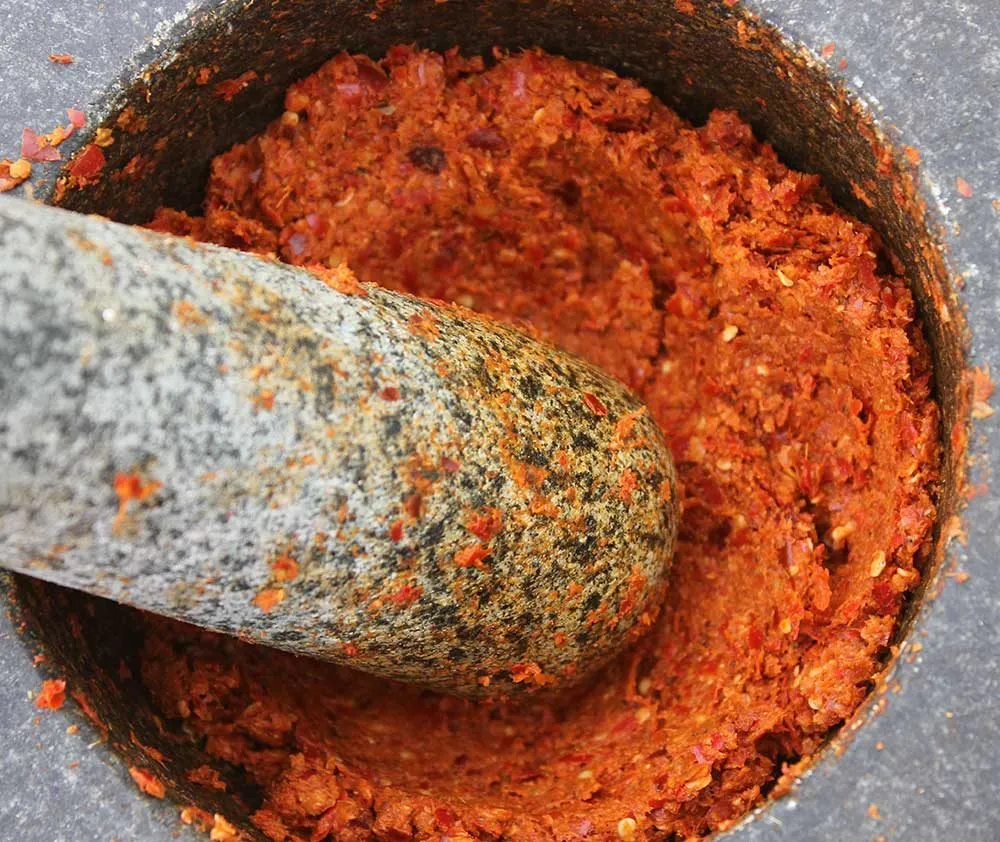
This is the red Thai curry paste recipe that has been in my family for generations: dried red chillies, lemongrass, galangal, kaffir lime skin and shrimp paste, pounded by hand in a pestle and mortar. Feel free to tweak things if you’re missing an ingredient, but for the true, authentic taste, follow it as closely as you can.
What is Thai Red Curry Paste?
Thai red curry paste is the foundation of red curry, a pounded blend of dried red chillies, garlic, shallots, lemongrass, galangal, kaffir lime skin and shrimp paste. The dried chillies give it both its heat and its deep red colour. If you're trying to decide between curries, find out which is hotter, red or green Thai curry.
Most often it’s simmered with coconut milk and meat, seafood or vegetables to make a red curry, but it also works in stir-fries, soups and marinades. If you find your finished curry too thin, my guide on thickening curry without flour or cornflour has several solutions.

What Does “Prik Gaeng Phet” Mean?
In Thailand we call this paste prik gaeng phet (พริกแกงเผ็ด). You’ll also see it romanised as prik gaeng ped or nam prik gaeng phed. The name tells you exactly what it is: prik means chilli, gaeng means curry, and phet means spicy, so quite literally “spicy curry chilli paste”. Curry pastes as a family are also called khrueang gaeng, “curry ingredients”.
That word phet is worth noticing. Of all the everyday Thai pastes, this is the one named after its heat, because red curry was traditionally the fiery one, even though most Western restaurant versions have been toned right down. The version below is the proper, fragrant, medium-hot original.
Is It Essential to Use a Pestle and Mortar?

For a paste like Thai red or green curry paste, yes, and here’s why:
1. Texture: Pounding lets you control how coarse or smooth the paste ends up. A blender chops; a pestle crushes, which is what breaks the fibres of lemongrass and galangal down properly.
2. Aroma: Crushing releases the essential oils gradually, so the paste smells stronger and tastes deeper than a blended one.
3. Tradition: It’s how this paste has been made in my family for generations. Every genuine red Thai curry paste recipe will tell you to use a pestle and mortar.
The honest trade-off: pounding takes the best part of an hour and it’s a workout. A little technique helps: don’t hammer straight down. Angle the pestle and drag it against the side of the mortar, which tears the fibres apart rather than just bruising them, and keep scraping everything back into the middle. If you’re short on time, a blender will still give you a decent paste, just not quite the same one.

Can You Use a Food Processor Instead?
Yes, and I won’t pretend Thai home cooks never do. If you go this route, there are two tricks that make all the difference. First, add a spoonful of oil rather than water to get the blades moving: water makes the paste stew instead of fry when it hits the pan later, while oil lets it bloom properly. Second, give it real time, a good five minutes of processing, scraping the sides down as you go, until the paste is fine and slightly moist rather than wet.
My compromise, same as with my green curry paste: pound the lemongrass, galangal and kaffir lime skin in the mortar first, because they’re the toughest, most fibrous ingredients and the machine struggles with them. Then transfer everything to the processor to finish. You get most of the aroma for a fraction of the arm-ache.
Traditional Red Thai Curry Paste Recipe
Feel free to change things up if you can’t find all the ingredients, but if you want it to be authentic then follow it to a tee, since this is the version my family has made for decades.
Authentic Red Thai Curry Paste
Equipment
- Pestle and Mortar
Ingredients
- 50 g dried red chillies
- 1 tbsp shrimp paste
- 20 g garlic
- 20 g shallots
- 20 g lemongrass
- 20 g galangal
- 15 g kaffir lime skin

What Each Ingredient Does (And What You Can Swap)
Every ingredient in this paste earns its place, so before you start swapping things, let me explain what each one is doing.
Dried red chillies are the soul of the paste, bringing the heat and the deep red colour, which both come from the same place. In Thailand we use dried spur chillies (prik chee fa haeng), which are fragrant rather than ferociously hot. In the UK, any large dried red chillies from an Asian grocer work well, and dried guajillo chillies from the world food aisle are a very respectable substitute. If you want a milder paste, shake out some of the seeds after soaking. You’ll lose a little colour along with the heat, but the flavour stays.
Lemongrass and galangal are the backbone of nearly every Thai curry paste, giving clean citrus from one and a sharp, almost piney bite from the other. Please don’t swap galangal for ginger; they look like cousins but taste nothing alike, and ginger will pull the whole paste in a sweeter, hotter direction. Kaffir lime skin (these days more politely called makrut lime) is the deal-breaker ingredient: intensely fragrant, with no substitute. We use the zest in the paste rather than the leaves because leaves are too tough to pound down.
Garlic and shallots add sweetness and body, peppercorns bring the warm background heat Thais cooked with before chillies even arrived in the country, and a pinch of salt does double duty: it acts like grit in the mortar to help break everything down, and it helps preserve the finished paste. Finally, shrimp paste (kapi) gives the deep, savoury, faintly tangy saltiness that ties the whole paste together. If you’re vegetarian you can leave it out, as I say in the method below. The paste will be lighter but still very good.
How to Make Red Thai Curry Paste
Once you have all the ingredients sorted, the first thing you should do is soak your chillies in some hot water. 20 minutes should be enough to soften them and make cutting them up a bit easier. In the meantime you can begin cutting up the rest of the ingredients. When the chillies have softened up cut them up as well.

Place the peppercorns in the mortar and begin pounding, when they start to break down add in a pinch of salt just to help preserve your curry paste and make it last longer.
Next in is the galangal and then shortly after, the lemongrass, garlic and shallots. Keep pounding away! The last ingredient before the chillies go in is the kaffir lime skin.

Keep pounding away until everything starts to break down. When it looks like the photo below you can put the chillies in. It’s better to put half in at a time. If you’ve got a good technique you are roughly half an hour away from finishing!

Keep pounding away until it’s really started to become a paste. That’s when the shrimp paste goes in. The shrimp paste will give the curry a real tangy flavour. If you are vegetarian you can skip it.

Another ten or fifteen minutes and you should be done!
You probably won’t use all this curry paste in one go so make sure you keep it refrigerated in an airtight container. It will last quite a few days.

Watch the Video For a More Detailed Explanation
Red vs Green vs Panang vs Massaman Paste
People mix these up constantly, so here’s how the four big Thai curry pastes compare. The red paste on this page is the parent of the family, since Panang and Massaman are both built on a red-paste base.
| Paste | Chillies | Heat | What sets it apart |
|---|---|---|---|
| Red (prik gaeng phet) | Dried red spur chillies | Medium-hot | The all-rounder: bright, fragrant, deep red colour |
| Green (gaeng khiao wan) | Fresh green bird’s eye chillies | Hottest | Fresh, herbal and sharper, because the fresh chillies make it fiercer than redd |
| Panang | Dried red chillies | Milder | Red-paste base mellowed with ground roasted peanuts, rich and thick |
| Massaman | Dried red chillies | Mildest | Red-paste base plus warm dry spices: cinnamon, cardamom, cloves |
If you’re weighing up which curry to cook, my red vs green curry guide goes into the flavour differences properly.
How to Use Your Red Curry Paste
Now, the step that matters more than any other: don’t just stir this paste into a pot of coconut milk. Fry it first. Spoon the thick cream from the top of a tin of coconut milk into a hot wok and let it simmer until the oil starts to separate out, which we call “cracking” the cream. Then fry the paste in it for three to five minutes. You’ll see the colour deepen from bright red to a glossy orange-red and the kitchen will smell amazing. That frying releases all the fat-soluble flavour in the chillies and aromatics; skipping it is the single biggest reason homemade red curry tastes flat or metallic.
As a guide, use 2–3 tablespoons of paste per 400ml tin of coconut milk for a curry that serves four. Homemade paste is fresher and punchier than shop-bought, so start at the lower end and taste. Serve the finished curry with jasmine rice, and if the sauce ends up looser than you’d like, my guide to thickening curry without flour will sort it out.
And red curry paste is far more than red curry. In Thailand the same paste goes into tod mun pla (those wonderful bouncy fish cakes), pad prik king (a dry stir-fry with green beans, no coconut milk at all), choo chee sauces for fish and prawns, soups, and marinades for grilled chicken or pork. One batch of this recipe makes about four curries’ worth, so there’s plenty to experiment with.
How to Store Homemade Red Curry Paste
Keep the paste in an airtight container in the fridge and it will be happy for up to two weeks, and the salt we pounded in at the start helps preserve it. For longer storage, freeze it in tablespoon-sized portions: an ice cube tray wiped with a little oil works perfectly. Once frozen solid, pop the cubes into a freezer bag and they’ll keep for a good three months. The best part is you don’t need to thaw them. Drop a frozen cube straight into the cracked coconut cream and it melts in as it fries. For the full fridge and freezer timings, see how long homemade Thai curry paste lasts.
Which Shop-Bought Red Curry Paste Is Best?
Making your own paste is genuinely rewarding and I want you to try it at least once. But I cook for hundreds of people at festivals, and I’m not pounding paste for all of them! Like with my green curry paste, the brand I reach for is Mae Ploy: it’s the most balanced and authentic of the widely available pastes, properly concentrated, and made with real shrimp paste.
Maesri (the one in little tins) is decent too, though saltier and a bit weaker, so you may need more of it. The supermarket jars (Thai Kitchen, Blue Dragon, Thai Taste) are much milder and gentler than the real thing; usable in a pinch, but expect to double the quantity. One trick I genuinely recommend: use a shop-bought paste as the base and pound in some fresh galangal and a little kaffir lime zest. Five minutes of work brings a jarred paste surprisingly close to homemade brightness.
Frequently Asked Questions
Is red curry paste spicier than green curry paste?
No, it's usually the other way round. Green curry paste is made with fresh bird's eye chillies, which are hotter than the dried spur chillies in red paste, so a traditional green curry has more bite. Red curry sits at a fragrant medium-hot. I compare them properly in my red vs green curry guide.
What dried chillies should I use for red curry paste in the UK?
Large dried red chillies from any Asian grocer are ideal, being the closest thing to Thai spur chillies (prik chee fa haeng). Dried guajillo chillies, now common in supermarket world-food aisles, are a slightly milder but very good substitute. Avoid tiny dried bird's eye chillies on their own, as the paste will be ferociously hot.
Can I make red curry paste in a food processor?
Yes, add a spoonful of oil (not water) to get it moving and process for a good five minutes, scraping down the sides. Water makes the paste stew rather than fry later. For the best result, pound the lemongrass, galangal and lime skin in a mortar first, then finish everything in the processor.
What can I use instead of shrimp paste?
For a vegetarian paste, simply leave it out. The paste loses a little savoury depth but still works beautifully. If you want to replace that umami, a teaspoon of white miso or a small piece of finely chopped dried shiitake mushroom pounded in does a respectable job.
Can I use ginger instead of galangal?
No, they look similar but taste completely different. Galangal is sharp, citrusy and almost piney, while ginger is sweeter and hotter, and it will change the character of the whole paste. Most UK Asian supermarkets sell fresh galangal, and it freezes very well, so stock up when you find it.
How long does homemade red curry paste last?
Up to two weeks in an airtight container in the fridge, and the salt in the paste helps preserve it. Frozen in tablespoon-sized portions it keeps for about three months, and you can drop a frozen cube straight into the pan without thawing.
How much red curry paste do I need for one curry?
Use 2–3 tablespoons per 400ml tin of coconut milk for a curry serving four people. Homemade paste is stronger than shop-bought, so start with less and add more to taste. One batch of this recipe makes enough for about four curries.
Should I remove the seeds from the dried chillies?
It's up to your heat tolerance. In red curry paste the heat and the red colour both come from the same chillies, so shaking out some seeds after soaking gives you a milder paste with only a small loss of colour. For the traditional medium-hot paste, leave them in.
What else can I make with red curry paste besides curry?
Lots, because it is one of the most versatile pastes in the Thai kitchen. Thai fish cakes (tod mun pla), pad prik king stir-fried green beans, choo chee sauce for salmon or prawns, spicy soups, and marinades for grilled chicken and pork all start with this same red paste.
What's the best shop-bought red curry paste?
Mae Ploy, without question. It's the most authentic and concentrated of the widely available brands. Maesri is a decent saltier alternative, while supermarket jars like Thai Kitchen and Blue Dragon are much milder, so you'll need roughly double the amount.



Comments