
Exploring the distinct differences between Thai and Chinese cuisine
As a Thai chef, I get asked this more than almost anything else: what's actually different between Thai and Chinese food? They're often lumped together on takeaway menus, but they're built on completely different foundations: different core ingredients, different cooking methods, and very different ideas about what a finished dish should taste like. Here's how to tell them apart, from the ingredients to the cultural traditions behind them. And if you're a Thai person in England trying to navigate these differences while finding food, check out our Thai survival guide to food in England.
Thai cuisine: what makes it unique

Thai cooking is built on the balance of four elements in a single dish: sweet, salty, sour and spicy. A good Thai cook adjusts these constantly while cooking, adding a squeeze more lime or a touch more fish sauce, until the dish hits all four at once.
The flavour profile is bold and vibrant. Most dishes draw on a combination of sweet (palm sugar), salty (fish sauce or soy sauce), sour (lime or tamarind), and spicy (chilli peppers). Underpinning that are aromatic herbs and spices: lemongrass, galangal, kaffir lime leaves, and Thai basil all contribute to the distinctive Thai aroma. Coconut milk is another staple, adding a creamy and slightly sweet element to curries and soups. Green, red, and yellow curries are the obvious examples.
Rice comes with nearly every meal. Sticky rice and jasmine rice are the most common varieties, though the choice depends on region. Thailand is also famous for its vibrant street food culture: Pad Thai, Som Tam (green papaya salad), and Satay skewers are all street staples. And the cuisine varies significantly by region. The northern region is known for hearty dishes like Khao Soi, while the south offers fiery, seafood-rich cooking like Tom Yum Goong.
Chinese cuisine: diversity is key

Chinese cuisine is incredibly diverse, with regional variations that reflect the vastness of the country and its deep-rooted culinary traditions. China’s geography has produced eight major regional styles, including Sichuan, Cantonese, Hunan, and Shandong, each with distinct flavours and cooking techniques.
Rice and noodles are staples across most regions, often serving as the foundation for a meal. Steamed rice, fried rice, and a wide variety of noodles (lo mein, chow mein) are all widely enjoyed. Chinese cooking also relies on a broad palette of sauces and seasonings: soy sauce, oyster sauce, hoisin sauce, and black bean sauce all provide depth and complexity.
The range of cooking techniques is equally impressive, from stir-frying and deep-frying to steaming, braising, and roasting. The wok is central to Chinese cooking, and Dim Sum has become a beloved tradition in its own right: small, flavoursome dishes such as dumplings, buns, and rolls served with tea. Sichuan cuisine in particular is known for its numbing Sichuan peppercorns and fiery chilli peppers.
Cultural influences on Thai and Chinese cuisine
Thai vs Chinese food FAQ
What is the difference between Thai and Chinese food?
Thai food is built on fresh aromatic herbs, fish sauce, coconut milk, and chilli heat. Chinese food spans a much broader range of regional styles and relies more heavily on soy sauce, oyster sauce, and fermented bean pastes. Thai dishes typically use fish sauce, coconut milk, lemongrass, galangal, and kaffir lime leaves — none of which are central to Chinese cooking.
What makes Thai cuisine unique compared to Chinese cuisine?
Thai cuisine balances sweet, salty, sour, and spicy flavours in most dishes, using a distinctive set of ingredients such as lemongrass, galangal, kaffir lime leaves, Thai basil, fish sauce, and coconut milk. Coconut milk is a staple in many Thai curries, adding a creamy and slightly sweet element not typically found in Chinese cooking.
Is Thai food spicier than Chinese food?
Thai food tends to be hotter and more herb-forward overall. However, Chinese food spans a wide range — from the mild sweetness of Cantonese cooking to the numbing heat of Sichuan cuisine, which uses Sichuan peppercorns and fiery chilli peppers.
What are the main staple ingredients in Thai vs Chinese cooking?
In Thai cooking, the main staples are jasmine rice, fish sauce, coconut milk, lemongrass, galangal, and kaffir lime leaves. In Chinese cooking, the staples tend to be soy sauce, oyster sauce, hoisin sauce, black bean sauce, and a variety of noodles and rice.
What are some popular Thai dishes and Chinese dishes to illustrate the differences?
Popular Thai dishes include Pad Thai, Green Curry, Som Tam (papaya salad), and Tom Yum Goong. Popular Chinese dishes include Peking Duck, Kung Pao Chicken, Dim Sum, and Mapo Tofu. The flavour profiles and key ingredients of these dishes clearly illustrate the distinct differences between the two cuisines.
The differences between Thai and Chinese food go beyond ingredients and cooking techniques. Thailand’s cuisine draws on a mix of indigenous traditions and influences from neighbouring countries including India, Cambodia, and Malaysia. Buddhism, Thailand’s dominant religion, has also shaped the food significantly, with monks driving a strong vegetarian and vegan thread through Thai cooking. Chinese cuisine, by contrast, is rooted in thousands of years of history. Trade along the Silk Road and China’s maritime routes brought in ingredients and techniques from across the world, producing the rich and diverse culinary landscape seen today.
The difference between Thai and Chinese food: popular dishes
Looking at popular dishes from each cuisine makes the contrast tangible.
On the Thai side, Pad Thai is stir-fried rice noodles with prawns or chicken, flavoured with tamarind, fish sauce, and lime. Green Curry is a coconut milk-based curry with green chilli peppers and Thai basil. Som Tam is a spicy green papaya salad with lime, fish sauce, peanuts, and chillies. Tom Yum Goong is a hot and sour prawn soup built on lemongrass, kaffir lime leaves, and galangal.
On the Chinese side, Peking Duck features crispy roasted duck served with thin pancakes, hoisin sauce, and julienned vegetables. Kung Pao Chicken is a stir-fry with chicken, peanuts, and vegetables in a spicy, slightly sweet sauce. Dim Sum offers a variety of bite-sized dishes including dumplings, steamed buns, and rolls. Mapo Tofu is a spicy Sichuan dish made with tofu, minced pork, chilli bean paste, and Sichuan peppercorns.
Regional variations within Thai cuisine
Just as Chinese cuisine has distinct regional styles, Thai cuisine also varies significantly by region, and these differences rival the diversity within Chinese food:
Northern Thai (Lanna) cooking relies heavily on sticky rice and uses minimal coconut milk. The flavours are earthy, less sweet than Central Thai, and draw on strong influences from Myanmar and Laos. Fermented ingredients like nam pla (fish sauce) are central; Khao Soi (curry noodles) and sai oua (sausage) are the signature dishes.
Northeastern Thai (Isaan) is the spiciest and sourest regional style. It's dominated by sticky rice, lime juice, and fresh herbs, with very little coconut milk. Som tam (green papaya salad) and larb (meat salad) are Isaan staples, and the flavour profile is assertively sharp and fiery.
Can't decide what to eat tonight?
Take our 60-second quiz and we'll pick for you
Central Thai (Bangkok) represents the most balanced approach, the style found in most Thai restaurants around the world. It makes heavy use of coconut milk, fish sauce, palm sugar, and fresh herbs. Tom yum, pad thai, and green curry are all Central Thai.
Southern Thai (Phuket) is seafood-forward and heavily spiced with turmeric and dried chilli, with abundant use of shrimp paste and fish sauce. Curries are thicker and less coconut-heavy than Central Thai, shaped by strong Malaysian and Indian influences from the region's geography.
Understanding these regional differences explains why a dish from Northern Thailand tastes completely different from a Southern Thai version, much as Sichuan food differs dramatically from Cantonese food.
Dining customs and how you eat: Thai vs Chinese traditions
Beyond flavour and ingredients, Thai and Chinese cuisines differ fundamentally in how they're served and consumed:
Thai dining places all dishes on the table simultaneously, arranged in the centre for communal eating. Diners share from common plates using serving spoons and take individual portions. Rice is the base; the other dishes are complementary toppings. Meals are eaten with a fork and spoon (spoon in the right hand, fork in the left), not chopsticks. Every diner tastes the entire meal at once.
Chinese dining is often structured in courses: appetisers, then main dishes, finishing with soup or noodles. Dishes are shared, but each place setting has an individual bowl. Rice or noodles come at the end rather than the beginning, and chopsticks are the primary utensil. The meal progresses through courses rather than being laid out all at once. Dim sum is its own category here, with small dishes arriving continuously throughout the meal.
These differences reflect cultural values. Thai dining emphasises communal sharing and harmony. Chinese dining emphasises structured progression and individual portions within a communal setting.
Cooking techniques: wok vs pestle and mortar
While both cuisines use similar tools, the emphasis differs dramatically:
Thai cooking relies heavily on the mortar and pestle (kratip) to pound curry pastes, spice blends, and salad dressings from scratch before anything hits the heat. High-heat stir-frying is used, but mainly for finishing. Steaming (wrapped in banana leaves or cooked in a clay pot) is equally important, and grilling over charcoal is the traditional method for proteins. The emphasis is on building flavour through paste preparation, not through wok heat alone.
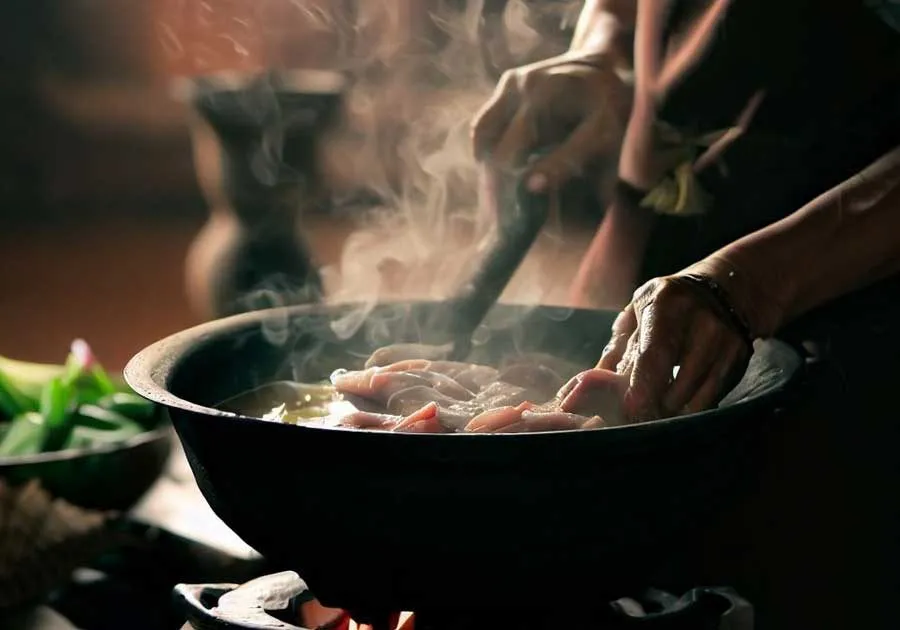
Chinese cooking prizes the wok's high heat and technique. The "breath of the wok" (wok hei) is something Chinese cooks train for: heat management, timing, and motion are all critical. Pastes are used, but they're often pre-made or added during cooking rather than pounded fresh. Steaming in bamboo or metal baskets is common, though stir-frying dominates. Clay pot cooking is a regional speciality, particularly in Cantonese cuisine.
This is why Thai cooking often starts with 5–10 minutes at the mortar and pestle, while Chinese cooking places its demands on speed and heat control once prep is done.
Vegetarian and vegan options: how each cuisine adapts
Thai cuisine is naturally vegetarian-friendly, partly due to Buddhist influence (vegetarian observance days are a cultural norm). Tofu, vegetables, and legumes are kitchen staples rather than substitutions. Vegetable-based curries, stir-fries, and salads lose little in authenticity without meat because the herbs and spices carry the dish. Fish sauce is often the only non-vegetarian component; removing it or swapping for soy sauce slightly changes the flavour but doesn't break the dish. Coconut milk-based curries work particularly well in vegetarian form.
Chinese cuisine offers vegetarian options, but meat is more central to most classic dishes. Peking duck is inherently non-vegetarian; Kung Pao Chicken requires protein substitution that alters the dish more noticeably. Dim sum does include vegetarian standards (vegetable dumplings, tofu dishes), and stir-fried vegetables appear on most menus. However, many dishes are cooked in oyster sauce or wok-kissed with pork fat for depth, so substituting requires more technique to maintain the same result.
In practice, Thai restaurants can usually produce convincing vegetarian versions of most dishes on the menu. Chinese restaurants' vegetarian offerings, while improving, can feel more like substitutions than dishes designed that way from the start.
Celebrating diversity through food
Thai and Chinese cuisines offer genuinely different experiences at the table. Thai food is built on the harmonious balance of sweet, salty, sour, and spicy in a single dish. Chinese cuisine draws its strength from regional diversity and a remarkably wide range of cooking techniques. Both reflect deep cultural histories that stretch back centuries.
Whether you’re savouring a fragrant bowl of Thai green curry or working through a feast of Chinese dim sum, each cuisine rewards you differently: Thai with its bold, layered seasoning, Chinese with its sheer regional variety and technique. The next time you sit down for a meal, the differences between the two are worth noticing rather than glossing over. Each dish carries the stories, traditions, and cultures that shaped it. If Thai food has caught your interest, our Thai recipe collection is a good place to start cooking.
Sources
Thai regional cuisines: Thailand Foundation (Thai Food), part of the Ministry of Culture's Department of Cultural Promotion.


Comments