An introduction to Isaan food
Isaan-style Thai food, also known as Isaan food, hails from the northeastern part of Thailand, specifically the region known as Isaan. It stands out as a distinct regional cuisine, separate from the more familiar central Thai cuisine, offering a unique culinary experience shaped by the region’s culture, climate, and agricultural practices. For a broader look at all of Thailand’s regional cuisines, see our introduction to Thai food.
What is Isaan food?
Isaan food is hot. Chilli goes into nearly everything, and the fermented fish and the fresh herbs keep it from being simply hot. If you like heat, you will like this food.
Sticky rice, locally known as “Khao Niew,” plays a central role in Isaan cuisine. It’s often served in small bamboo baskets and serves as both a staple and an essential utensil. Diners use sticky rice to pinch and scoop up the various dishes, and it is very good for that.
Grilled meats, particularly marinated and skewered chicken, pork, or beef, are a common sight in Isaan cuisine. They usually come with a small pile of dipping sauces, and the whole thing is eaten standing up.
Fermented ingredients are a significant component of Isaan food, with “pla ra” or fermented fish sauce being a notable example. This fermented sauce is used to season dishes and contributes a unique Isaan flavour.
The use of local herbs and vegetables, some of which are foraged from the region’s forests and fields, also adds to the unique flavour. These fresh and indigenous ingredients are what make Isaan food taste different from central Thai food.
The cuisine of Isaan has been influenced by its proximity to neighbouring countries, particularly Laos and Cambodia. These influences are evident in dishes like sticky rice, variations of larb, and the use of local herbs and spices, which are popular in both neighbouring countries.

Where is Isaan?
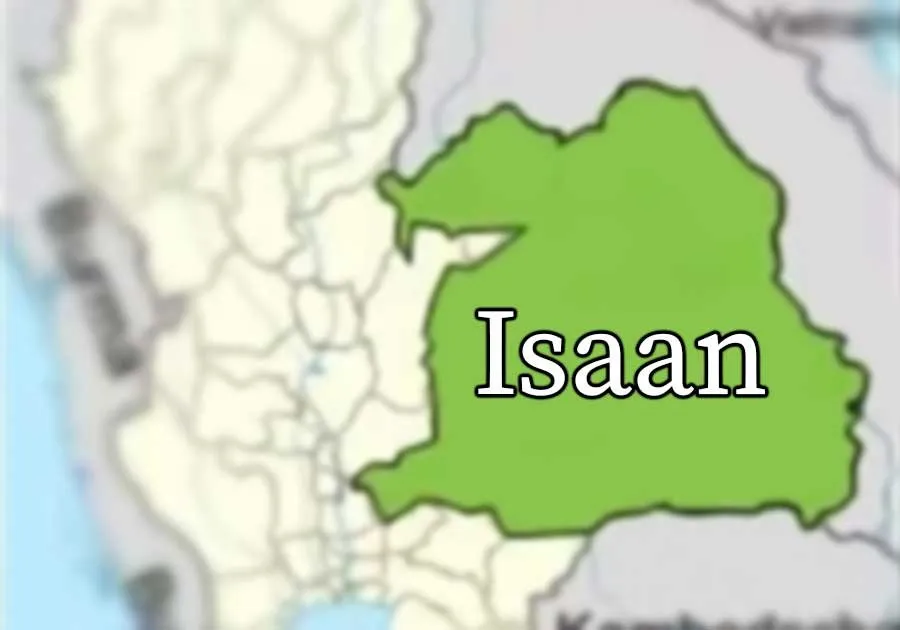
The north-eastern region of Thailand is known as Isaan and as you would expect, the food of the region is known as Isaan food. Most of Isaan is situated on a high plateau divided by the Phu Phan mountains with Laos and Cambodia also bordering it. These two countries have had a strong culinary influence on Isaan food. Laos in particular as many Isaan people fled Laos in the 1970s after the communist uprising.
It’s often said there are more Lao people in Issan than there are in Laos! How true this is though, I don’t know.
Isaan was one of the first areas in Thailand and Asia to grow rice. Jasmine rice is cultivated over much of Issan but in recent years rainfall has become unreliable, making life hard for the local farmers.
Why fermentation defines Isaan: survival and climate strategy
Fermented ingredients like pla ra (fermented fish) and sai krok isaan aren't just flavour choices; they're survival adaptations. Isaan's climate is characterised by unreliable rainfall and a long dry season, making food preservation critical for sustaining communities between harvests.
Fermentation solved this problem. Fish caught during the rainy season were preserved in salt, allowing communities to eat protein year-round. The process also creates umami depth: fermented fish provides glutamates that make other dishes taste richer without added salt, stretching limited resources further. Sticky rice, fermented sausages, and preserved vegetables all reflect this "preserve through fermentation" philosophy.
Understanding fermentation as survival strategy, not just taste preference, reveals why Isaan food tastes the way it does. The sourness, saltiness, and funk of fermented ingredients aren't accidental; they're the result of centuries of adaptation to geography. This is what makes Isaan food fundamentally different from Central Thai cuisine, which relies more on fresh herbs and coconut milk.
Sourcing Isaan ingredients: finding authenticity outside Thailand
One barrier to authentic home cooking is sourcing. A lot of recipes list "pla ra" and "toasted rice powder" without explaining where Western cooks actually find them.
Sticky rice (khao niew) is the easiest to track down. Asian markets and online retailers stock it under the name "glutinous rice" or "sweet rice." Avoid short-grain sushi rice; the starch structure is completely different. A 5-lb bag costs around $8–12 and keeps for years.
Fermented fish sauce (pla ra) is available from Asian markets or online suppliers. It's pungent and smelly, and that's exactly how it should be. Brands like Megachef are affordable and authentic. If you can't find it, regular fish sauce will work in a pinch, though the flavour is weaker. Don't skip fish sauce entirely; it's the backbone of Isaan taste.
Toasted rice powder (khao khua) is simpler to make than to buy. Most Isaan cooks toast uncooked sticky rice in a dry pan until golden, then pound it. The whole process takes about five minutes, and the homemade version is better and cheaper than anything pre-made. Store it in an airtight container and it keeps for months.
Fresh herbs such as mint, coriander, and Thai basil are available at most supermarkets and farmers' markets. If fresh isn't available, freeze coriander and mint in ice-cube trays with water; they're fine for cooking, though not for garnish.
Bird's eye chillies can be found fresh or frozen at Asian markets. Thai chilli flakes work as a substitute (use roughly half the quantity), but regular red chillies don't have the heat, so avoid those.
For a steamer, the traditional bamboo cone (kratip) costs $10–20 and lasts for decades. A metal steamer basket is a workable alternative, though bamboo keeps the rice warmer during serving.
Authentic Isaan vs. restaurant versions: what you should know
Not all larb is the same. There's a real difference between home-cooked Isaan food and what restaurants serve, especially outside Thailand.
At home, locals eat raw or lightly cooked minced meat (larb sod), heavy on herbs and toasted rice powder, with minimal oil and moderate heat. It's eaten with sticky rice and raw vegetables such as cabbage and long beans. The flavour is herbal, complex, and sour from lime and fish sauce rather than sweet. Texture matters too: toasted rice powder should be visible and crunchy, not dissolved into the dressing.
Restaurant versions, particularly those adapted for tourists, tend to use fully cooked minced meat (safer from a food-safety standpoint), less toasted rice powder (often omitted entirely), and a sweeter dressing with more palm sugar to suit Western palates. They arrive on a plate with a garnish rather than in a communal sticky rice basket. Easier to eat, but less authentic.
When ordering, it's worth asking whether the larb uses raw meat (sod) and whether toasted rice powder (khao khua) is included. A kitchen that can answer those questions clearly is one that takes Isaan food seriously. If the staff look puzzled, the dish probably wasn't made the way Isaan people make it.
Dining customs: how Isaan meals work
Isaan food isn't designed to be eaten individually. Understanding the meal structure reveals why these dishes taste the way they do.
Sticky rice is the centrepiece. A large basket sits in the middle of the table and diners tear off a piece with their right hand to use as a scoop for curries, salads, and grilled meats. The rice absorbs flavours and textures while providing a neutral base for intense dishes. Eating without it fundamentally changes the experience; it's not a side dish, it's the meal's foundation.
Dishes are shared rather than portioned. A family of four might have four or five dishes in the centre: larb, som tam, grilled chicken, stir-fried vegetables, and soup. Everyone eats from everything throughout the meal. This is why Isaan dishes are so intense and complex. You're not meant to eat a full bowl of som tam; you'll eat a spoonful with rice, move to larb, then come back to the som tam.
Heat tolerance is respected but not accommodated. Dishes arrive as cooked, which is spicy by Western standards. Fresh chillies, fish sauce, and lime juice sit on the table for those who want more. Asking for less spice is uncommon; the usual approach is to eat more sticky rice and vegetables to temper the heat.
Can't decide what to eat tonight?
Take our 60-second quiz and we'll pick for you
Raw vegetables are always served alongside: cabbage, long beans, cucumber, and fresh herbs. These aren't garnish. They're eaten between bites of spicy dishes, providing textural contrast and cooling relief. This is why Isaan meals feel balanced despite their apparent intensity.
Popular Isaan food
Som Tum (green papaya salad)

Som Tum is the dish everyone orders. It is shredded green papaya with lime, fish sauce, palm sugar and chilli. The sweet, sour, spicy and salty all arrive at once, which is the point of the dish. Som Tum often includes additional ingredients like tomatoes, green beans, and peanuts, adding layers of crunch and complexity to the dish.
Larb (Laap)

Larb is a flavourful Isaan minced meat salad that captures the essence of the region’s cuisine. Ground meat, whether chicken, pork, or beef, is cooked with a medley of aromatic herbs and spices, and then dressed with lime juice and fish sauce. A key element is the toasted rice powder, which imparts a nutty flavour and a pleasing crunch. Fresh mint and coriander lift the dish, while toasted ground rice (khao khua) gives it a subtle crunch and nutty depth: the detail that separates real larb from imitations.
Sticky rice (Khao Niew)

Sticky rice, known as “Khao Niew,” is the cornerstone of Isaan meals. This glutinous rice is steamed to perfection and served in small bamboo baskets. Its unique texture and slightly sweet flavour make it the ideal accompaniment to the region’s bold and spicy dishes. Sticky rice is not just a side dish but also an essential utensil, as diners use it to scoop up and savour the other elements of their meal.
Kai Yang (grilled chicken)

Kai Yang is grilled chicken, the Isaan answer to barbecue. The chicken is typically seasoned with a mixture of herbs, garlic, and spices, then grilled over charcoal, imparting a smoky and aromatic flavour. It’s often served with a selection of dipping sauces that elevate the dish to a culinary masterpiece.
Sai Krok Isaan (Isaan sausage)

Sai Krok Isaan is a uniquely flavourful fermented sausage made from ground pork, garlic, and sticky rice. The mixture is packed into casings and left to ferment, resulting in a distinct sour and slightly spicy taste. It’s a beloved Isaan snack and is often enjoyed with fresh herbs and vegetables.
Isaan food may not be for everyone

Some things in Isaan cuisine may not be for everyone though! Insects and frogs are often eaten in Isaan and red ants are used as a seasoning in some dishes. If you’re travelling around this part of Thailand check the menu carefully before ordering!
The region’s adventurous approach to food includes the consumption of insects, frogs, and even the use of red ants as a seasoning in certain dishes. For those unaccustomed to these unique culinary experiences, it’s advisable to exercise caution when exploring the Isaan food scene.
In Isaan, various types of edible insects are considered delicacies and are often enjoyed as snacks or incorporated into dishes. These insects can range from crispy crickets and grasshoppers to protein-rich mealworms and bamboo worms. While they are a good source of nutrition and add a crunchy texture to dishes, their consumption can be an acquired taste for those unfamiliar with entomophagy, the practice of eating insects.
Frogs are another protein source commonly featured in Isaan cuisine. These amphibians are prepared in various ways, from deep-frying to grilling. The tender meat of frogs has a flavour reminiscent of chicken or fish and is appreciated for its versatility in Isaan dishes. However, some diners may hesitate to try frog meat due to its unconventional nature.
If you’re travelling through the region, order what the locals are eating. Menus rarely do the food justice, and pointing works fine. If you have reservations about trying these unconventional ingredients, don’t hesitate to ask the restaurant staff or locals for recommendations on more familiar dishes that align with your taste preferences.



Comments