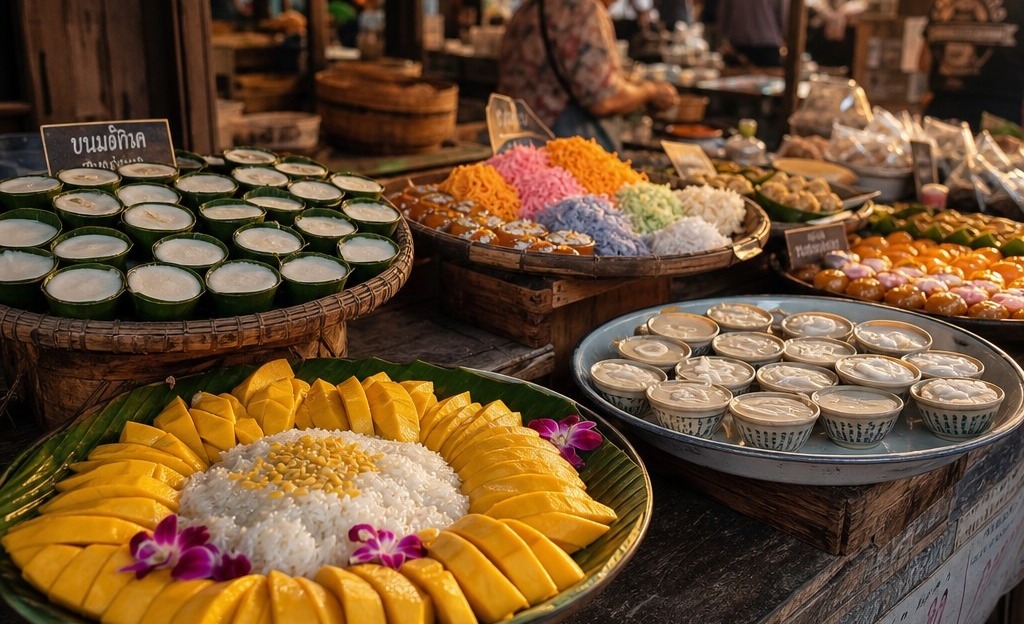
If you think Thai food is all about chillies and fish sauce, the desserts will surprise you. Thai sweets are gentle, fragrant, and built almost entirely on coconut milk. Where a British pudding might reach for cream and butter, a Thai dessert reaches for coconut cream and palm sugar. The result is a family of sweets that are naturally dairy-free, frequently vegan, and unlike anything in the Western dessert canon.
I grew up in my grandmother's kitchen in Chiang Mai, where dessert was never an afterthought. After meals she would bring out small bowls of whatever was in season: bananas simmered in coconut milk, sticky rice with mango, or cups of steamed coconut custard. The ones that stuck with me all share the same backbone: good coconut milk. Below I've gathered the ten Thai coconut milk desserts every home cook should know.
A note before we begin: Thai desserts operate differently from Western ones. They are less sweet, more subtle, and built on contrast, warm rice against cool fruit and sweet coconut against a finish of salt. The textures matter as much as the flavours: chewy, bouncy, creamy, crunchy. Once you understand this framework, every dessert on this list makes sense.
Why coconut milk is the backbone of Thai desserts
Thailand's tropical climate means coconut palms grow everywhere, along roadsides and in back gardens, with entire plantations across the central and southern regions. Coconut milk, kati in Thai, became the foundation of dessert cooking because it was available, affordable, and extraordinarily versatile. Cows were not historically kept in Southeast Asia, so there was no dairy tradition the way Europe developed one. Coconut milk fills the role of cream, butter, and milk all at once, which is why so many Thai desserts happen to be vegan and dairy-free by default without ever trying to be.
There are two forms you need to know:
- Coconut milk (kati) is the liquid squeezed from grated mature coconut meat. The first pressing yields thick cream; subsequent pressings with water produce thinner milk.
- Coconut cream (hua kati) is literally the "head of the coconut milk", the thick fatty layer that rises to the top. It's used as a finishing drizzle or topping, always with a pinch of salt to balance sweetness.
A good coconut milk for Thai desserts should be at least 60% coconut extract. I use Aroy-D (available in cartons and cans) or Chaokoh, both of which are widely available in UK supermarkets and Asian grocers. Thai Taste brand is also reliable and sold at Tesco and Sainsbury's. Avoid light coconut milk for desserts; the result will be thin, watery, and disappointing. You need the fat content to get the right texture and mouthfeel.
One more thing: never let coconut milk boil hard. High heat causes it to split. The fat separates from the liquid and you end up with a grainy, oily mess. Gentle simmering is all it needs. If it does split despite your best efforts, a teaspoon of rice flour whisked in can sometimes bring it back together.
Key techniques and ingredients
Steaming (neung)
The most common technique for Thai coconut desserts. Gentle, moist heat creates silky custards without browning or curdling. Always steam over medium heat and keep the water at a steady simmer, not a rolling boil. Wrap the lid in a clean kitchen towel to absorb condensation so droplets do not fall onto the custard surface and create pockmarks. Custards are done when the centre still trembles slightly, because they carry on cooking from residual heat after you take them off.
Simmering (tom)
Used for desserts like bananas in coconut milk and black sticky rice pudding. Keep the heat low and steady, a gentle simmer and never a hard boil, or the coconut milk will split into oily pools. Stir occasionally to prevent the starch from settling and scorching on the bottom. The dessert is ready when the main ingredient has softened and the liquid has thickened slightly.
Palm sugar (nam tan peep)
Made from boiled-down sap of coconut or palmyra palm flowers. It has a deep, caramel flavour with smoky, buttery undertones and a lower glycemic index than refined white sugar. The texture is dense and puck-like, so you need to grate or dissolve it before use. In the UK, substitute dark brown sugar, muscovado, or coconut sugar. Do not use white sugar alone, because you lose the complexity that makes Thai desserts distinct.
Salt
Salt is not optional in Thai desserts. Every coconut cream topping has a pinch of salt. It lifts the sweetness and stops the dessert from tasting flat. This salty-sweet contrast is the defining characteristic of Thai sweets and the thing most home cooks get wrong.
How Thai desserts are served
Most Thai coconut desserts are served at room temperature or with crushed ice, and rarely straight from the refrigerator. The idea is to let the flavours open up. Desserts made with sticky rice should be served while the rice is still slightly warm, because the rice firms up as it cools. Iced desserts like tub tim krob and ruam mit are assembled just before serving: the crushed ice goes in first, then the components, then the coconut milk poured over the top.
Portions in Thailand are smaller than Western dessert servings. A single khanom thuay cup or a small bowl of bua loy is enough after a meal. Thai desserts are also commonly shared, with several small dishes placed in the middle of the table for everyone to pick at.
The 10 best Thai coconut milk desserts
 Mango Sticky Rice
 Khanom Thuay
 Kluay Buat Chee
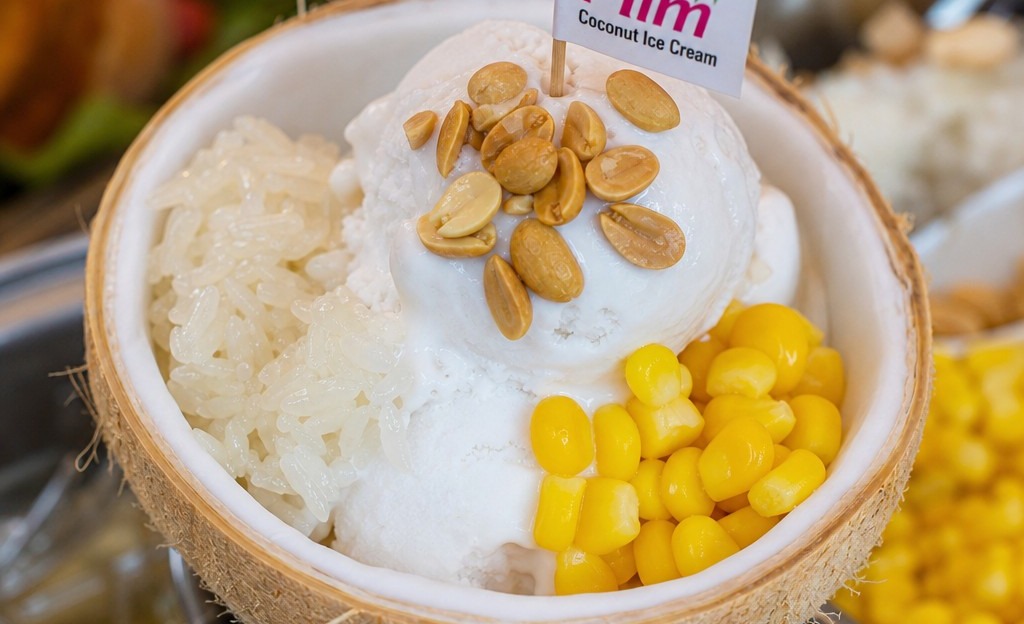 Coconut Ice Cream
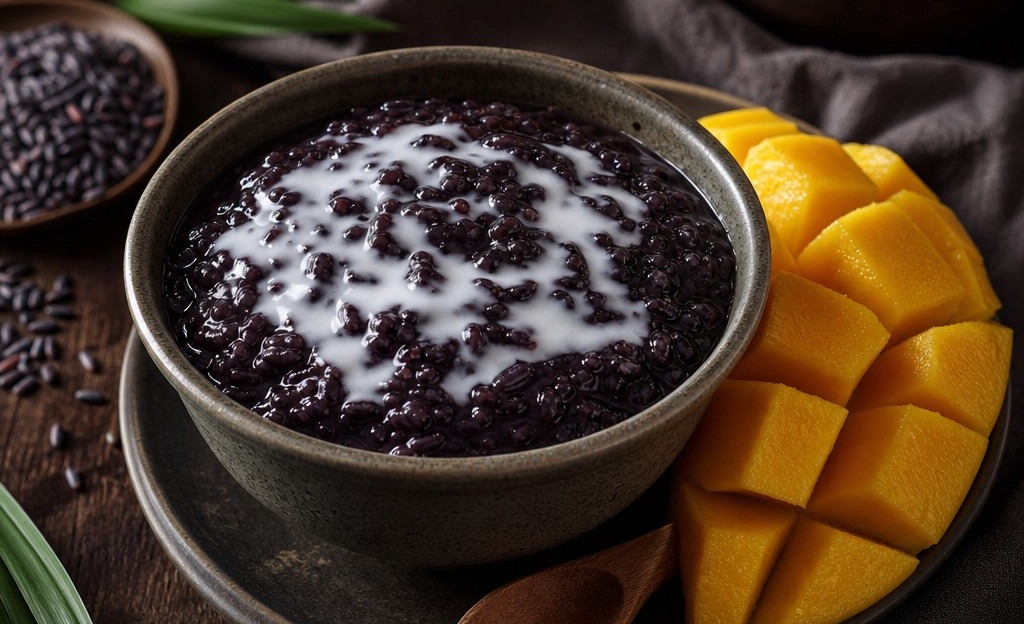 Black Sticky Rice
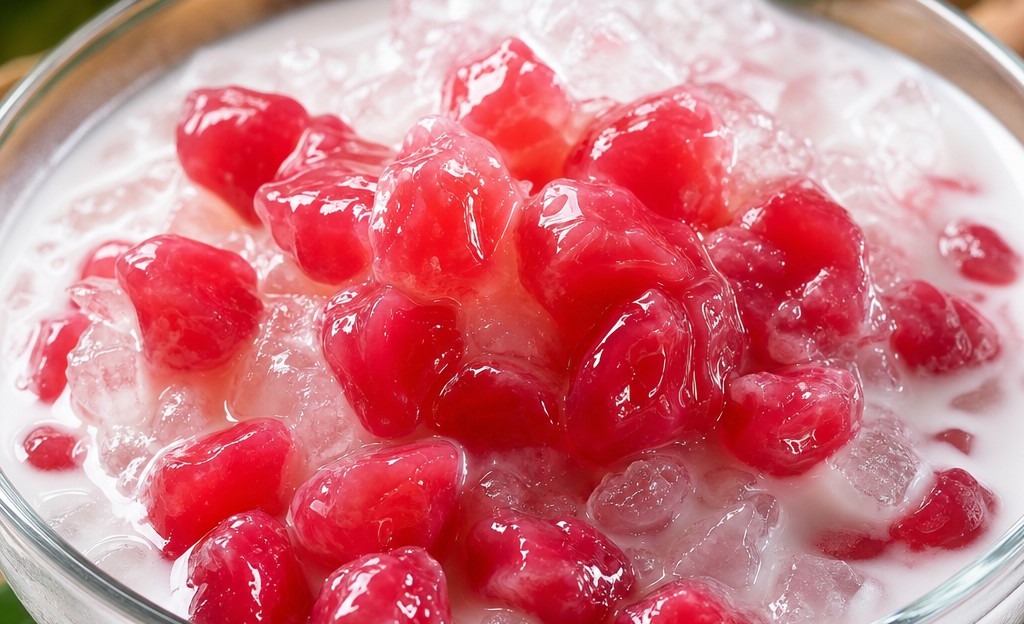 Tub Tim Krob
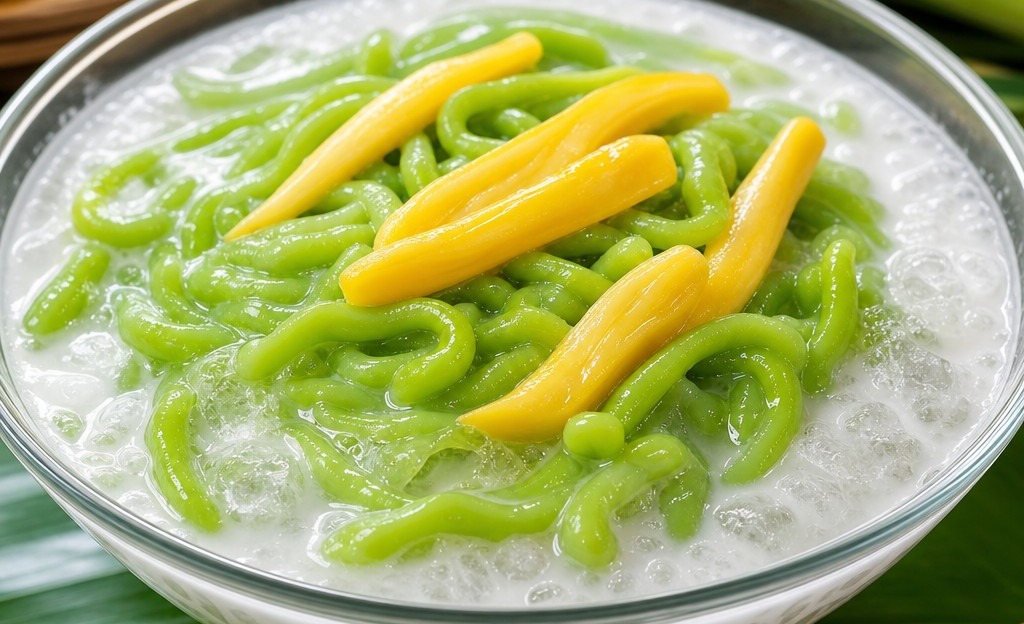 Lod Chong
 Sangkaya
 Bua Loy
 Ruam Mit
1. Mango Sticky Rice (Khao Niao Mamuang)
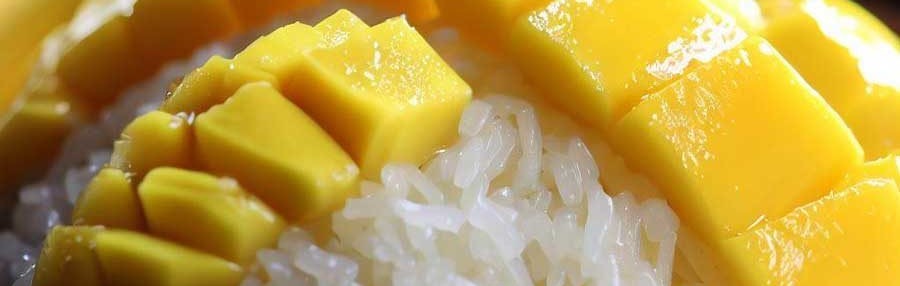
Thailand's national dessert and its most famous coconut milk sweet. Sticky rice is soaked overnight, steamed until tender, then dressed while still warm in sweetened coconut milk infused with salt and pandan leaf. The rice absorbs the liquid and becomes creamy, fragrant, and slightly glossy. It is served alongside slices of ripe mango, drizzled with thick salted coconut cream, and finished with a sprinkle of crunchy toasted mung beans.
The magic is in the contrasts: warm, creamy rice against cool, juicy mango; sweet coconut against the salt finish. The rice should be soft but still hold its shape, the mango should be aromatic enough to perfume the whole plate, and the coconut cream should be rich enough to coat everything. Mango sticky rice originates from the central region and is traditionally eaten during mango season, roughly March to May. It is one of the few Thai desserts that has travelled successfully across the world, but most versions abroad miss the salt balance entirely and end up tasting one-dimensionally sweet.
UK substitutions: how to ripen a mango quickly Use Nam Dok Mai mangoes from Asian grocers when they are in season, or ripe Alphonso or Kent mangoes. The rice must be Thai glutinous rice. Do not substitute jasmine rice, sushi rice or any other variety, because the texture will be wrong. Toasted mung beans can be replaced with toasted sesame seeds, which are easier to find. I have written a dedicated mango sticky rice guide if you want the full step-by-step method.
2. Khanom Thuay (Steamed Coconut Custard Cups)
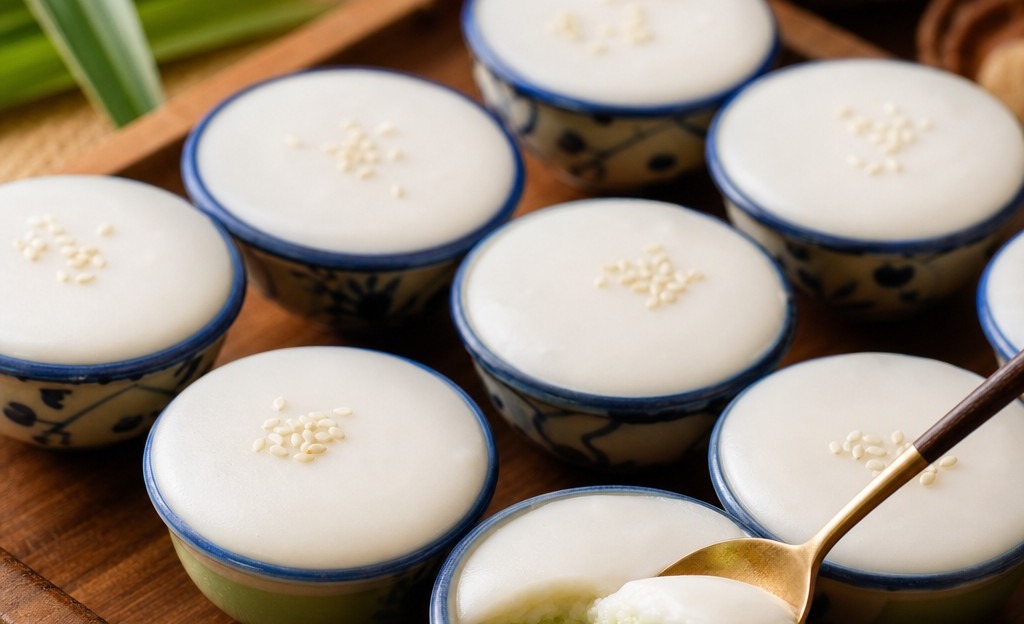
A two-layered steamed custard served in small ceramic cups, and one of the most elegant desserts in the Thai repertoire. The bottom layer is sweet, made with palm sugar, rice flour, and pandan juice (which turns it a pale green). The top layer is creamy, salty coconut cream poured over once the bottom has set. The contrast between the sweet base and the salty top is the whole point, because your spoon cuts through both layers in every mouthful. Gluten-free and vegan.
Khanom thuay dates to the Ayutthaya period and was influenced by Portuguese egg-based desserts introduced by Maria Guyomar de Pinha, the Thai-Portuguese woman known as the "Queen of Thai Desserts." Her influence on Thai sweets is hard to overstate; she is responsible for several of the desserts on this list. Today khanom thuay is common at temple ceremonies and sold at noodle shops across Thailand. Locals often finish a bowl of boat noodles with a couple of these little custards.
UK substitutions: Use small ramekins or silicone muffin cups if you cannot find the traditional ceramic cups. Rice flour and tapioca starch are available in most UK supermarkets. Pandan extract from Asian grocers works well; if unavailable, simply omit it and the custard will be pale yellow from the palm sugar. Arrowroot flour can substitute tapioca starch.
3. Kluay Buat Chee (Bananas in Coconut Milk)
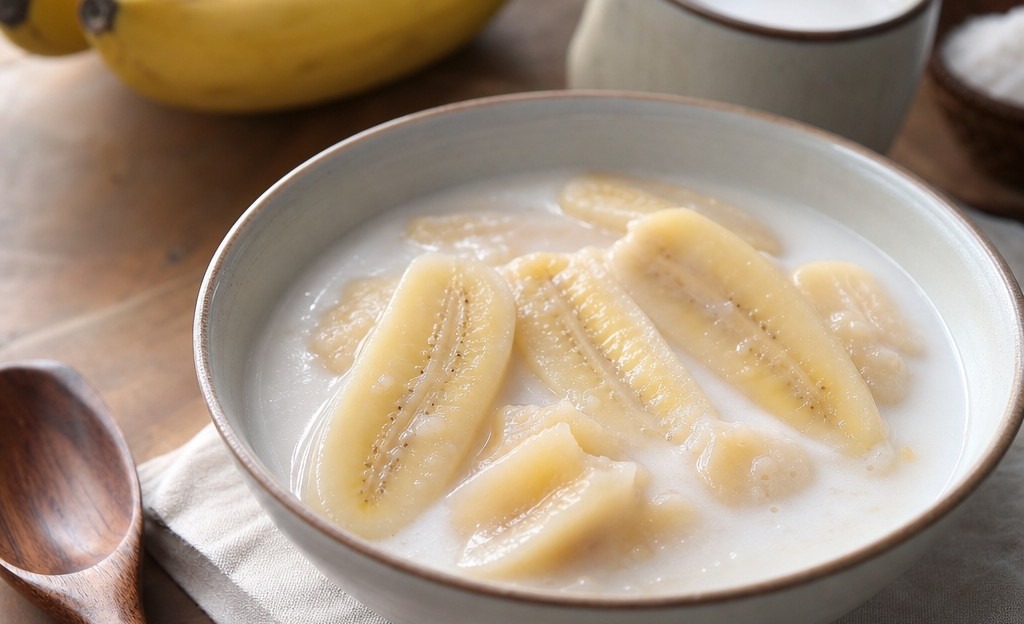
The simplest Thai coconut dessert: barely ripe bananas gently simmered in sweetened, lightly salted coconut milk. Four ingredients, twenty minutes, and the result is quietly perfect. The bananas soften and release their natural sweetness into the creamy coconut milk.
The name has a charming story: "kluay" is banana, "buat" means to ordain as a monk, and "chee" means nun. The white bananas "dressed" in white coconut milk supposedly resemble nuns in white robes. This is everyday comfort food in Thailand, eaten warm as an after-school snack or after dinner. No special occasion needed, no complicated technique required. It is the dessert Thai grandmothers make when they want something quick and satisfying.
UK substitutions: Use ladyfinger bananas or very firm Cavendish bananas. Palm sugar substitutes well with dark brown sugar or muscovado. Canned coconut milk is perfectly fine.
4. I-Tim Kati (Thai Coconut Ice Cream)
A dairy-free, egg-free ice cream that gets its creaminess purely from full-fat coconut milk. It is lighter and less cloying than Western ice creams because there are no eggs or double cream weighing it down. In Thailand it is often served in a coconut shell or, famously, stuffed into a soft hot dog bun for street portability. The bread-and-ice-cream combination sounds odd until you try it.
Street vendors across Thailand push wheeled carts with metal canisters, using a traditional hand-crank churn that produces a softer, silkier texture than machine-churned ice cream. The toppings are as important as the ice cream itself: roasted peanuts, sweet corn kernels, sticky rice, jackfruit, and a drizzle of condensed milk. It is naturally vegan if you skip the condensed milk drizzle.
UK substitutions: Full-fat coconut milk from the supermarket is fine, and Aroy-D cartons work particularly well. No ice cream maker? Freeze the mixture in a shallow dish and whisk thoroughly every 30 minutes for 3–4 hours to break up ice crystals. Toasted peanuts, canned sweet corn, and canned jackfruit are all readily available in UK supermarkets and Asian grocers.
5. Black Sticky Rice Pudding (Khao Niao Dam)
A rich, comforting pudding where black glutinous rice is simmered with pandan leaves until it breaks down into a creamy, porridge-like consistency, then sweetened with palm sugar. It is served with a generous drizzle of salted coconut cream and often topped with fresh mango, toasted coconut flakes, or crushed peanuts. The texture is softer and more rustic than white sticky rice desserts.
The black rice has a nutty, earthy flavour and releases a striking deep purple colour as it cooks, the result of natural anthocyanin pigments. It is more sophisticated than white sticky rice and has become increasingly popular in upmarket Thai restaurants abroad. Do not skip the salt in the coconut cream topping; it is what transforms this from a bowl of sweet porridge into something genuinely complex.
UK substitutions: Black sticky rice is available at Asian grocers (Hoo Hing, Wing Yip, Longdan). Pandan leaves can be bought frozen from Asian stores or substituted with a drop of pandan extract. Palm sugar substitutes well with dark muscovado or coconut sugar.
6. Tub Tim Krob (Red Rubies in Coconut Milk)
Water chestnuts diced into small cubes, dyed a vivid red, coated in tapioca starch, and boiled until the coating turns translucent. The result is a dessert that looks exactly like its name: jewel-like "rubies" with a remarkable two-texture bite: crunchy water chestnut inside, chewy tapioca shell outside. They are served chilled in sweetened coconut milk with crushed ice and strips of jackfruit.
The name "tub tim krob" means "crunchy ruby," and the visual effect is genuinely stunning: bright red gems suspended in white coconut milk. It is a celebration dessert, often served at parties and festive occasions, where the red colour symbolises prosperity and good fortune. The crushed ice is not optional. It dilutes the sweetness as it melts and keeps the dessert refreshingly cold.
UK substitutions: Canned water chestnuts are available in most UK supermarkets and Asian grocers; drain and dice them into even cubes. Tapioca starch is sold by Dove's Farm in the free-from aisle. For natural red colour instead of artificial food colouring, use beetroot juice. Canned jackfruit in syrup is available from Asian grocers.
7. Lod Chong (Pandan Noodles in Coconut Milk)
Chewy, worm-like green pandan noodles made from rice flour and tapioca starch, served in sweetened coconut milk with crushed ice and jackfruit strips. The name "lod chong" means "falling through", a reference to how the batter is pressed through a colander or special wooden press directly into boiling water, where it sets instantly into squiggly noodles.
This is the ultimate cooling dessert for Thailand's hottest months. It is closely related to Indonesian cendol (which uses mung bean flour and often includes grass jelly), though the Thai version is simpler and cleaner in flavour. The green colour and fragrance come entirely from pandan juice, so no artificial colouring is needed. The experience is all about texture: the slippery, bouncy noodles sliding through sweet coconut milk with the crunch of crushed ice.
UK substitutions: This is the hardest dessert on the list to make entirely from scratch. The easiest option is to buy premade lod chong noodles from the frozen section of Asian grocers. If making from scratch, use a potato ricer or a large-holed colander to press the batter through. Pandan extract is widely available in Asian stores and works as a substitute for fresh pandan juice.
8. Sangkaya (Coconut Egg Custard with Sticky Rice)
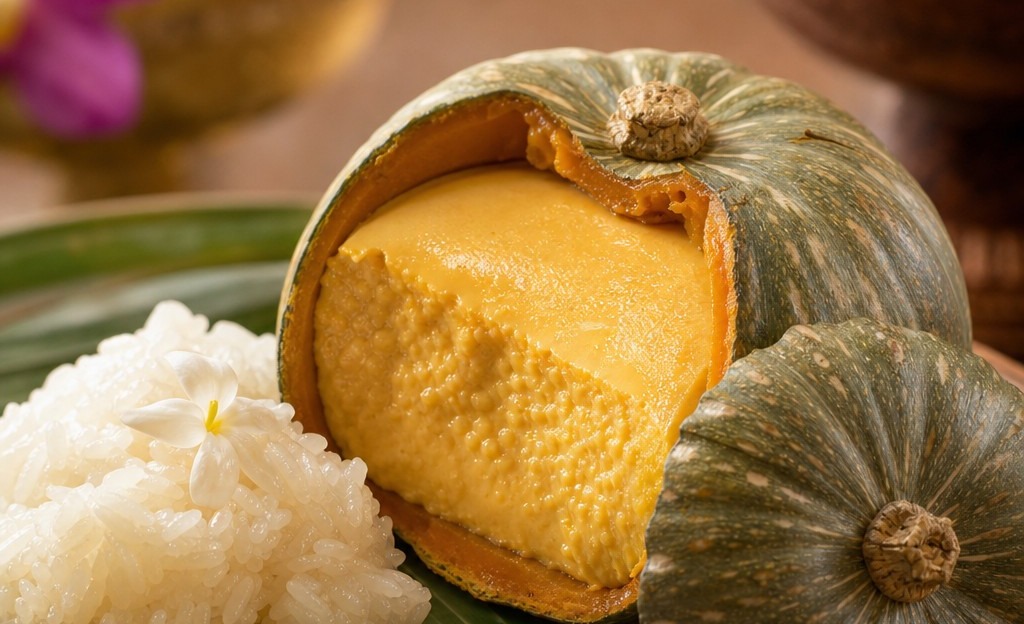
A velvety egg custard made with coconut cream, eggs, and palm sugar, steamed until it is silky smooth and trembling. It is served on a bed of sticky rice that has been dressed in sweetened coconut milk. The rice soaks up the custard at the edges and becomes part of the dessert. Sometimes the whole custard is steamed inside a hollowed-out pumpkin (sangkaya fak thong), which infuses it with a gentle squash sweetness. It is Thailand's answer to crème caramel, but with coconut cream replacing dairy and palm sugar replacing refined white sugar.
This dessert has direct Portuguese influence. Maria Guyomar de Pinha, the Thai-Portuguese woman who revolutionised Thai sweets in the 17th century, introduced egg-based custards derived from Portuguese convent confectionery. Sangkaya is one of her lasting contributions. It appears at temple offerings, family gatherings, and ceremonies, where its rich golden colour is considered auspicious.
UK substitutions: Works perfectly with UK eggs and supermarket coconut milk. Kabocha squash or butternut squash make excellent pumpkin substitutes for the baked version. Steaming is not negotiable, because the custard must cook gently over medium heat, covered with a cloth-wrapped lid to prevent condensation from dripping onto the surface.
9. Bua Loy (Floating Lotus Rice Balls)
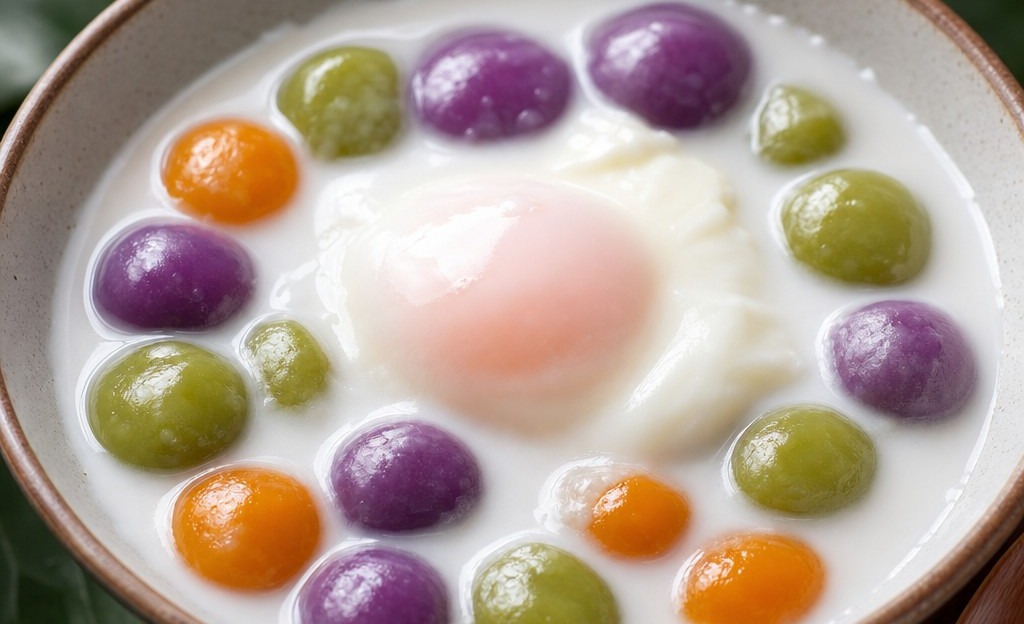
Chewy glutinous rice balls, similar to mochi, flavoured and coloured naturally with taro (purple), sweet potato (orange), pandan (green) or butterfly pea flower (blue). They float in a warm, sweet coconut milk broth fragrant with pandan, often accompanied by a poached egg and young coconut meat. The name "bua loy" means "floating lotus", because the colourful balls resemble lotus seeds floating on the surface of the water.
Bua loy is a comforting, warming dessert that works in any season. It is popular year-round in Thailand but especially during cooler months, when the warm coconut broth is genuinely soothing. The naturally coloured rice balls make it a favourite with children, and the poached egg, though unusual to Western palates, adds a richness that ties the whole bowl together.
UK substitutions: Glutinous rice flour from Asian grocers or online (Erawan brand is reliable). If taro is hard to find, substitute purple sweet potato for the same colour. The poached egg is optional but traditional. Serve warm; it does not reheat well once assembled.
10. Ruam Mit (Mixed Friends)
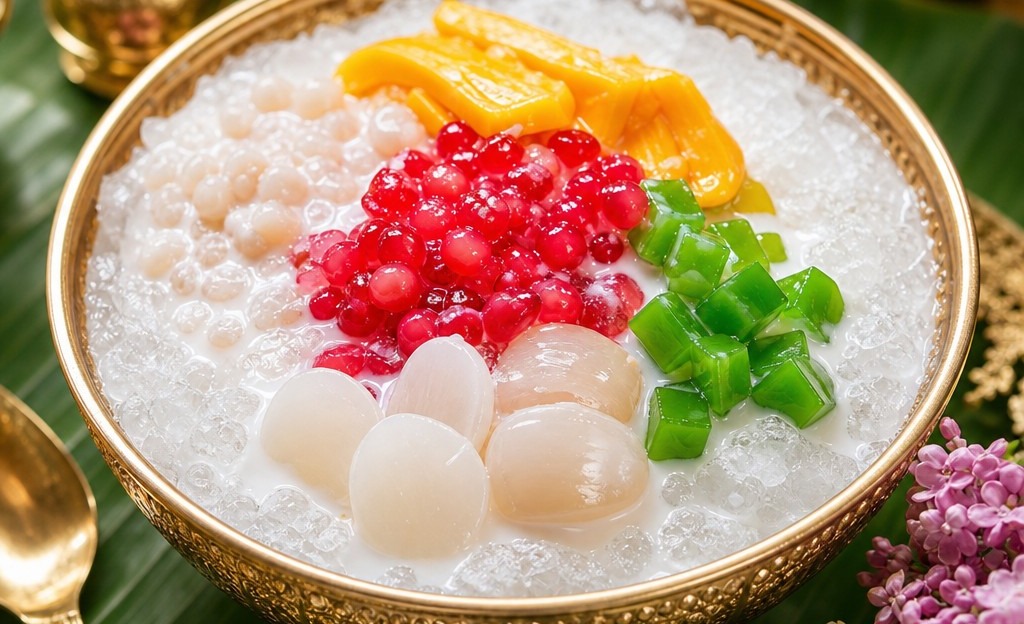
The ultimate "kitchen sink" dessert: a medley of Thai dessert ingredients gathered in one bowl of sweetened coconut milk over crushed ice. Red rubies, tapioca pearls, palm seeds, water chestnuts, coloured jelly cubes, jackfruit strips, and cubes of sweet potato or taro all come together in a single bowl. The name "ruam mit" means "gather friends". All the ingredients meet like friends, and no two versions are the same.
This is the most flexible dessert on the list and the easiest to make at home, because there are no rules. Use whatever Thai dessert components you can find or have already made. It is also the most visually impressive: a colourful, iced bowl of coconut milk with bright red, green, yellow, and white components peeking through.
UK substitutions: Jarred palm seeds, canned jackfruit, and coloured jelly cubes are all available from Asian grocers. This dessert is flexible by design, so use what you can source and do not worry about authenticity. The crushed ice is essential; without it the dessert is too sweet and one-dimensional.
Which Thai coconut desserts are vegan and gluten-free?
One of the best things about Thai coconut desserts: most are naturally vegan and gluten-free. Here's a quick reference:
| Dessert | Vegan? | Gluten-Free? | Serving Temp | Difficulty |
|---|---|---|---|---|
| Mango Sticky Rice | Yes | Yes | Warm/room temp | Medium |
| Khanom Thuay | Yes | Yes | Warm or chilled | Medium |
| Kluay Buat Chee | Yes | Yes | Warm | Very easy |
| Coconut Ice Cream | Yes | Yes | Frozen | Medium |
| Black Sticky Rice Pudding | Yes | Yes | Warm or chilled | Easy |
| Tub Tim Krob | Yes | Yes | Chilled with ice | Medium |
| Lod Chong | Yes | Yes | Chilled with ice | Hard |
| Sangkaya | No (eggs) | Yes | Room temp/warm | Medium |
| Bua Loy | Yes (skip egg) | Yes | Warm | Medium |
| Ruam Mit | Yes | Yes | Chilled with ice | Easy |
Where to buy Thai dessert ingredients in the UK
Most ingredients for these desserts are easier to find in the UK than you might think:
- Coconut milk: Aroy-D (cartons or cans) and Chaokoh are widely available in UK supermarkets and Asian grocers. Thai Taste brand is also reliable and sold at Tesco and Sainsbury's. Always buy full-fat, because the reduced-fat versions lack the richness Thai desserts depend on.
- Sticky rice: Must be Thai glutinous rice, sometimes labelled "sweet rice" or "glutinous rice." Look for Three Rings, Cock, or Green Dragon brands at Asian grocers, or buy online from Sous Chef or Thai Food Online. Regular jasmine rice will not work.
- Palm sugar: Available from Thai Food Online, Asian supermarkets, or Amazon UK. In a pinch, substitute dark muscovado sugar or coconut sugar, as both add the caramel complexity that white sugar lacks.
- Pandan extract/leaves: Frozen pandan leaves or bottled pandan extract from Asian grocers (Hoo Hing, Wing Yip, Longdan, SeeWoo). Pandan extract is more convenient and works well in custards; frozen leaves are better for infusing coconut milk.
- Mangoes: Nam Dok Mai mangoes from Asian grocers peak from March to May. Alphonso mangoes are a good substitute year-round and available at many UK supermarkets. Choose fruit that yields slightly to pressure and smells fragrant at the stem.
- Tapioca starch: Sold as tapioca flour or starch in the free-from aisle of most supermarkets (Dove's Farm brand), or cheaper at Asian grocers. Cornflour is not a direct substitute but works in some applications.
Frequently asked questions
Are Thai desserts very sweet?
Less sweet than Western desserts generally. Thai sweets balance sugar with salt (from coconut cream) and sometimes sour (from tropical fruits). The flavours are more subtle and layered.
Can I use light coconut milk?
You can, but the result will be thin and unsatisfying. Always use full-fat coconut milk with at least 60% coconut extract for desserts.
Is sticky rice gluten-free?
Yes. Despite the name, "glutinous" refers to the sticky texture, not gluten. Sticky rice is naturally gluten-free.
Can I make these desserts in advance?
Most hold well. Mango sticky rice is best the day it's made (rice hardens in the fridge). Custards like sangkaya and khanom thuay keep for 2–3 days in the fridge. Coconut ice cream keeps for weeks. Avoid refrigerating desserts meant to be served with crushed ice, or the ice melts and dilutes everything.
What's the most beginner-friendly dessert?
Kluay Buat Chee (bananas in coconut milk). Four ingredients, twenty minutes, nearly impossible to get wrong. Start there, gain confidence, then move on to mango sticky rice or black sticky rice pudding.
Are Thai desserts healthy?
They are desserts, so they contain sugar, but they have advantages over Western sweets: they are dairy-free, most are vegan, many are gluten-free, and coconut milk provides medium-chain triglycerides (MCTs) that are metabolised differently from dairy fats. Palm sugar has a lower glycemic index than white sugar. That said, mango sticky rice still runs 350–450 calories per serving, so treat it as a treat.
Ready to explore further?
Thai coconut desserts are a revelation for UK palates: less sweet than British puddings, naturally dairy-free, and built on the interplay of salty coconut cream and caramel-like palm sugar. They're not an afterthought in Thai cuisine; they're an integral, beloved part of the meal.
If you want to start cooking Thai food at home, my easy Thai recipes with chicken are a good place to begin. For more on how Thai ingredients work together, see my guide to common ingredients in Thai cooking. And if you've been wondering whether Thai food is healthy, I've written a full breakdown.
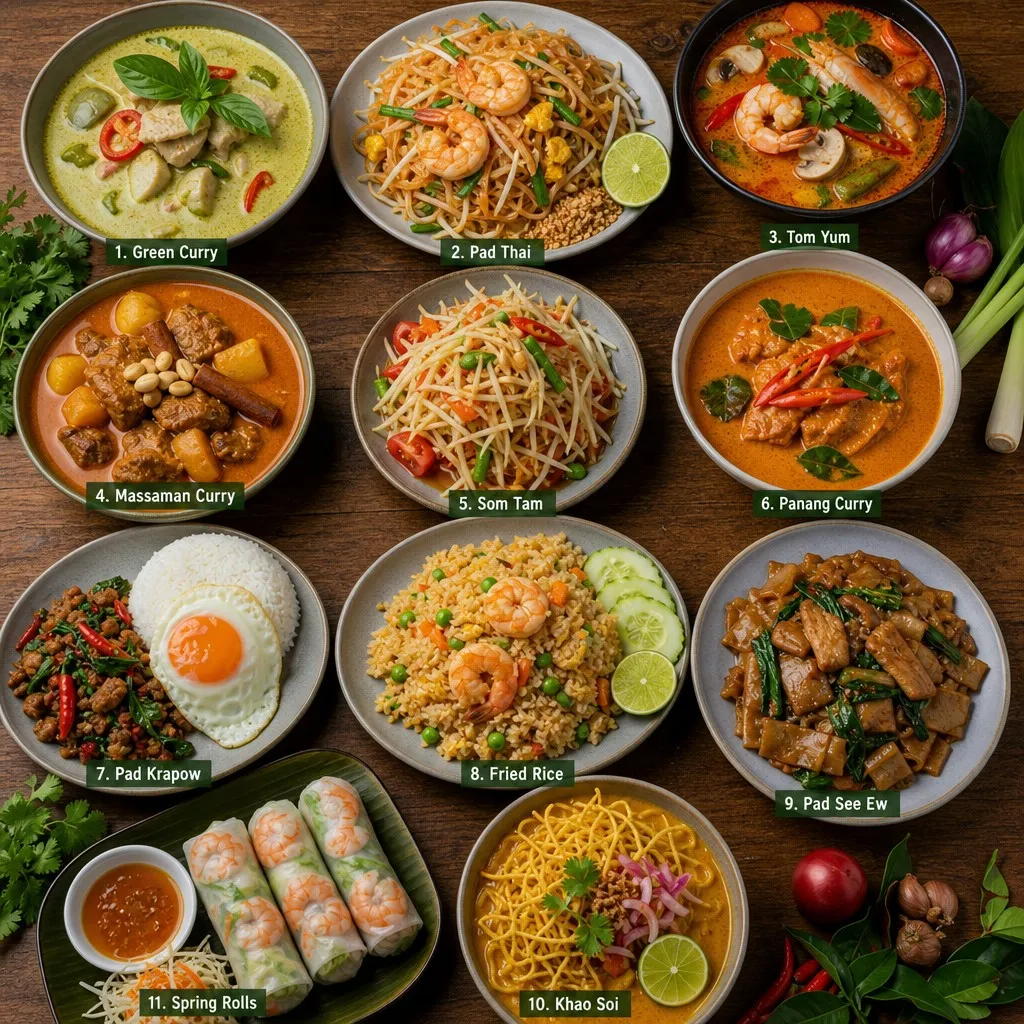
You might also enjoy learning about the 10 most popular Thai dishes or exploring the regional cuisines of Northern Thailand and Southern Thailand.


Comments