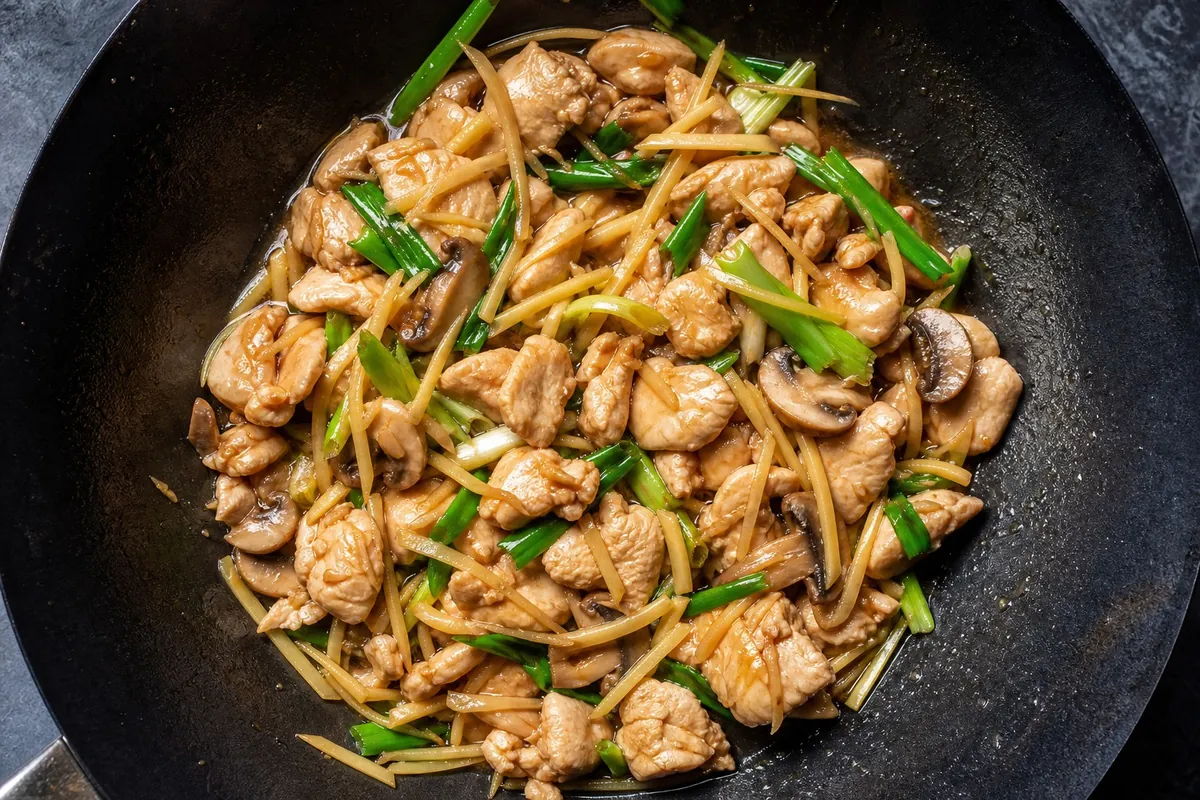
About Gai Pad King (ไก่ผัดขิง)
Gai Pad King, chicken and ginger stir fry, is a Thai home cooking staple that rarely appears on UK restaurant menus, which is a shame because it's genuinely delicious and takes about eight minutes to make. It was a regular in my family's kitchen growing up, and it's still one of the first things I cook when I want something fast and satisfying.
The dish relies on ginger doing two things at once: flavouring the sauce and adding texture. Cut it into thin matchsticks (julienne), not grated. Grated ginger dissolves and disappears; julienned ginger stays visible, caramelises slightly at the edges, and gives you something to bite into. That contrast between tender chicken, soft mushroom, and slightly chewy ginger is what makes the dish interesting.
The sauce uses three elements together: fish sauce, oyster sauce, and seasoning sauce. They create a round, savoury glaze that coats everything in the wok without being heavy. If you haven't used seasoning sauce before, this is a good recipe to start with, since it adds depth that fish sauce alone doesn't quite achieve.
Where Gai Pad King Comes From
Pad king (ผัดขิง), ginger stir fry, is one of those dishes you’ll find in home kitchens right across Thailand. It isn’t northern, southern or Isaan; it belongs to everyone. The technique shows its Chinese ancestry clearly: a hot wok, aromatics fried in oil, protein seared fast, and a savoury sauce to bind it all. Chinese immigrants brought this style of cooking to Thailand generations ago, and Thai cooks made it their own with fish sauce and fresh chillies.
What makes pad king distinctive is the sheer quantity of ginger. It isn’t a background aromatic here; it’s practically a vegetable in its own right, cut into matchsticks and eaten by the forkful. In Thailand you’ll see it made with chicken, beef, pork or even fish, usually decided by whatever’s in the kitchen that day. My family made it constantly when I was growing up in Chiang Mai, and it’s still the dish I reach for when someone in the house is feeling under the weather.
Getting the Ginger Right
Ginger is the whole point of this dish, so it’s worth a few minutes of your attention.
Young versus mature ginger. There are really two different ingredients hiding under one name. Young ginger (sometimes called spring ginger) has thin, almost translucent skin, pale flesh, around 30% less fibre, and a sweeter, gentler heat. Mature ginger, the wrinkled, tan-skinned stuff in every UK supermarket, is sharper, hotter and more fibrous. In Thailand, pad king is traditionally made with young ginger, which is why you can eat it in such generous quantities.
In the UK, young ginger is a seasonal treat. Dutch growers supply it around May and June, and you can find it through speciality suppliers like The Wasabi Company or good Asian grocers. The rest of the year, mature supermarket ginger works fine; just slice your julienne a little finer and, if it’s particularly old and hot, soak the matchsticks in cold water for ten minutes to soften the bite.
Why julienne, never grate. Cut the ginger into thin matchsticks with a sharp knife. Julienned ginger keeps its texture, releases its heat gradually as you chew, and caramelises slightly at the edges in the hot wok. Grated ginger does the opposite: it collapses into a wet paste, floods the wok with liquid, and turns the whole dish into one harsh, gingery note. A dull knife is nearly as bad; it crushes the fibres instead of cutting them, squeezing the juice out before the ginger ever hits the pan.
The chemistry of the wok. There’s a lovely bit of food science behind why stir-fried ginger tastes warming rather than sharp. Fresh ginger’s pungency comes from a compound called gingerol. Under high heat and moisture, exactly the conditions inside a wok, gingerol converts to shogaol and related compounds, which read as a deeper, rounder warmth rather than a raw bite. It’s the same reason raw ginger makes you wince but ginger in a stir fry feels soothing.

Why Three Sauces, Not One
People sometimes ask me why this recipe calls for fish sauce, oyster sauce and seasoning sauce. Couldn’t you just use more of one? You could, but the dish would be flatter, and you’d taste the difference immediately.
Each sauce does a different job. Fish sauce brings salt and fermented umami depth, the savoury backbone. Oyster sauce brings gentle sweetness, body and that glossy sheen that coats the chicken. Seasoning sauce is the bridge: lighter than both, it thins the glaze and ties the salty and sweet layers together so neither one dominates.
Lean on fish sauce alone and the dish turns harsh and salty. All oyster sauce and it goes sweet, heavy and one-dimensional. The three together, in roughly the 2:2:1 ratio I use here, give you a rounded, layered sauce from about thirty seconds of measuring.
Heat Management: Why the Order Matters
The recipe steps aren’t arbitrary; each one is about controlling temperature, and it’s worth knowing why.
Garlic goes in first, at moderate heat. Garlic burns fast, and burnt garlic is bitter enough to ruin the whole wok. Twenty to thirty seconds, just until it starts to turn golden and smells sweet, then move on. If your wok is screaming hot at this stage, you’ve got about a five-second window before it scorches, which is why I let the garlic set the pace rather than the other way round.
Chicken gets the high heat. Once the garlic is fragrant, turn the heat right up before the chicken goes in. You want a fast sear that keeps the juices inside, not a gentle simmer that steams the meat grey. The ginger joins shortly after, so its edges catch and caramelise in the hot oil.
Stock goes in mid-cooking, after the sauces. This bit matters more than people realise. The splash of stock loosens the glaze and stops the sauces reducing into an over-salty varnish. Add it too early and you boil the chicken; skip it and the sauce turns sticky and aggressive. A small splash at the right moment keeps everything glossy and balanced.
Chillies, onion and spring onion go in last so they keep their crunch and freshness. Total cooking time is about five minutes; the prep takes twice as long as the cooking, which is exactly how a stir fry should be.

Medicinal Comfort Food
In Thailand, pad king isn’t restaurant food; it’s the dish your mum makes when someone’s poorly. Ginger is treated as medicine as much as flavouring in Thai home cooking, and this stir fry is the standard response to an upset stomach, a cold, or general seasonal misery. The logic is simple: warm food, lots of stomach-settling ginger, gentle enough to eat when you don’t fancy anything fierce, but tasty enough that you’ll actually finish the plate.
That’s why you’ll rarely see it on UK Thai menus; it occupies the same place in Thai cooking that chicken soup does in the West. It’s family food, made quickly, eaten with plain jasmine rice, no ceremony. When I make it now, on a grey Dorset evening, it still does exactly the job it did in my family’s kitchen in Chiang Mai.
If you’re looking for a quick and easy stir fry this is definitely for you; it’s one of my favourite easy Thai recipes with chicken.

Having said that, if you’re serious about Thai food you may as well pick up a packet because they’re cheap and last for years (as long as you get the dry ones). They’re used in quite a few other Thai dishes and you can add them to just about any stir fry you want 🙂
Chicken Ginger Stir Fry (Gai Pad Ging – ไก่ผัดขิง)
Equipment
- 1 wok
Ingredients
- 1 tablespoon of cooking oil
- 300 g of sliced chicken breast
- 2 cloves of garlic crushed and finely chopped
- 50 g of julienne-cut ginger
- 100 g of sliced onion
- 50 g of sliced green chilli De-seed the chillies if you don't want it spicy or alternatively use red and green peppers instead.
- 50 g of sliced red chilli
- 1 sliced Asian mushroom
- 100 g of spring onions halved and then cut into 1-inch pieces
- 2 tablespoons of fish sauce
- 2 tablespoons of oyster sauce
- 1 tablespoon of seasoning sauce
- 2 teaspoons of sugar
- Some stock water
Instructions
- Preheat the wok and add the cooking oil.
- Stir-fry the garlic until it begins to change colour.
- Add the chicken and stir-fry until the pieces of chicken separate and then add the ginger and stir it altogether until the chicken is partially cooked.
- Add the oyster sauce, fish sauce, seasoning sauce, and sugar.
- Mix together thoroughly and then add the Asian mushroom.
- Add a small amount of chicken stock (just enough so that the chicken doesn’t dry out.)
- Bring it to the boil at which point the chicken should now be cooked.
- Add the chilli and onion and stir-fry it all together before adding the spring onions at the end.
Video



Comments