
Larb should be loud. Not politely spiced and not quietly savoury. It should hit you with salt, sour, heat, nuttiness and a rush of cold fresh herbs all at once. It is one of the great dishes of Isaan cuisine, and when it works, it is extraordinary. When it is bland, something specific is missing. In twenty years of cooking this dish I have found it is nearly always one of five things.
The good news is that all five can be fixed, even in a batch that is already cooked.
The quick answer
The single most commonly missing element in home larb is toasted rice powder (khao khua). It adds a nutty, earthy depth that no other ingredient replicates, and it is absolutely not optional. After that, the most frequent problems are using bottled rather than fresh lime juice, insufficient fish sauce, and herbs that are not genuinely fresh. Check all five elements before you conclude that something is wrong with your recipe.
What larb is supposed to taste like
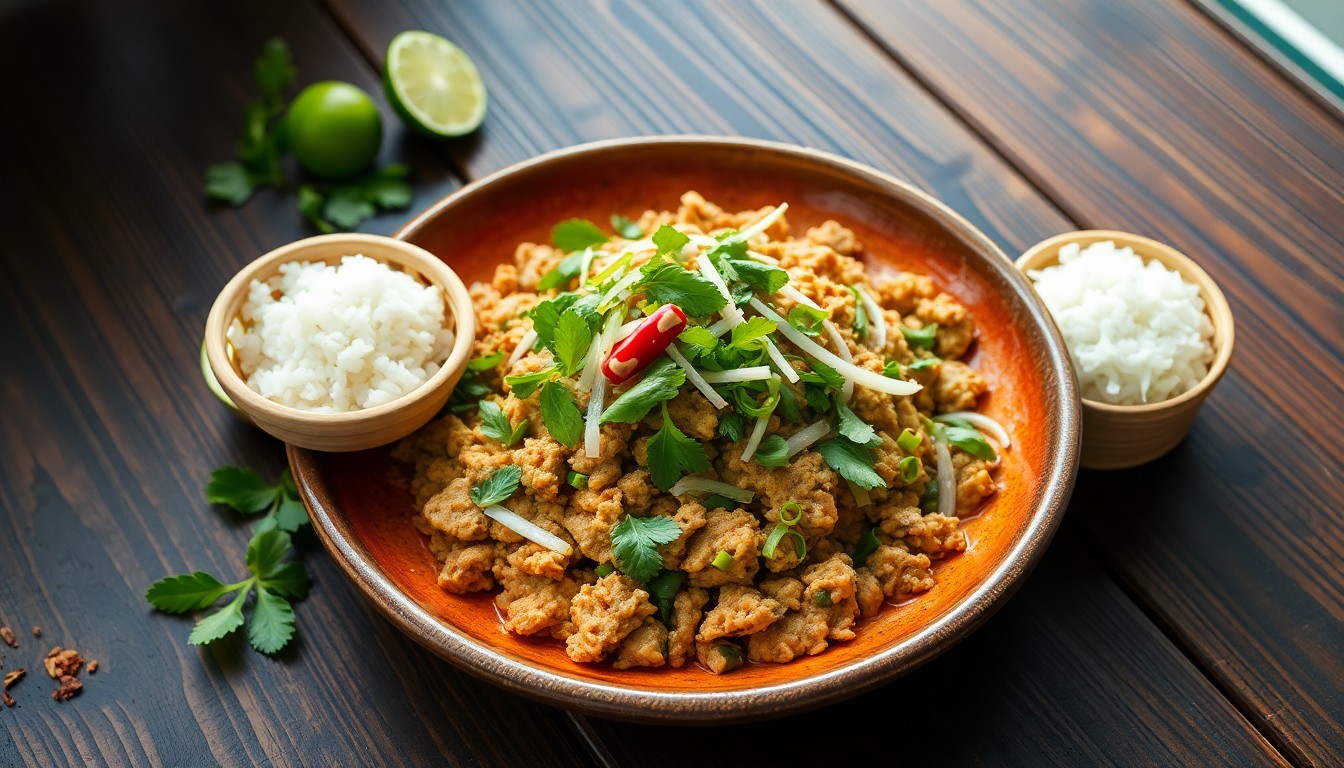
Larb (also spelled laab, laap or laap) is a minced meat salad that originated in Laos and became one of the signature dishes of northeastern Thailand (Isaan). Five elements have to be present and in balance:
- Salty: fish sauce, assertive and present
- Sour: fresh lime juice, bright and acidic
- Spicy: dried chilli flakes, a sustained warmth rather than sharp fresh heat
- Nutty and earthy: toasted rice powder, the element most home cooks skip
- Fresh and herby: mint, coriander and raw shallots, added cold at the very end
If any one of these is missing or undersized, the dish collapses from complex to flat. Larb is not supposed to be subtle. If yours tastes like slightly seasoned mince with some herbs on top, at least one of these five elements is wrong.
Element 1: toasted rice powder (khao khua)

Toasted rice powder, called khao khua in Thai (ข้าวคั่ว), is the ingredient most non-Thai recipes either omit or bury as optional. It is not optional. It provides a distinctive toasty, nutty depth that is completely irreplaceable, plus a fine, slightly gritty texture that gives larb its characteristic mouthfeel. Without it, the dish tastes flat even if every other element is present.
One detail matters more than people realise: use raw sticky rice (glutinous rice), not jasmine rice. Sticky rice has a different starch composition, and when toasted its flavour turns noticeably nuttier and more complex. Jasmine rice can stand in if it is all you have, but it is not traditional and the result is flatter. If your home rice powder smells weaker than the version in a good Isaan kitchen, the rice variety is usually why.
- Put 3–4 tablespoons of raw, uncooked sticky rice (glutinous rice) into a dry pan (no oil) over medium heat.
- Toast, stirring frequently, for 8–12 minutes until the grains turn a deep golden brown and smell like toasted bread or popcorn. Do not rush this, because pale beige rice powder is weak and flavourless.
- Tip onto a plate and leave to cool completely.
- Pound in a mortar and pestle or pulse briefly in a spice grinder to a coarse powder. Not dust, you want some texture.
- Use 1–2 teaspoons per portion of larb. Store the rest in a jar for up to two weeks.
Add the rice powder after the meat has been seasoned and removed from heat, stirring it in with the lime juice and herbs. It should coat the meat lightly and add both texture and a toasty background note to every mouthful.
Element 2: fish sauce, more than you think
Larb is generously seasoned with fish sauce, and most home cooks are too cautious with it. A single portion of larb made with around 200g of minced meat needs approximately 1–2 tablespoons of fish sauce. The saltiness should be prominent and present, not overwhelming, but definitely there.
Equally important: season the meat while it is still hot. Heat helps the fish sauce penetrate the meat rather than just sitting on the surface. If you season after the meat has cooled, you get surface saltiness that tastes sharp rather than integrated.
Use a good-quality fish sauce. Tiparos and Squid Brand are both excellent. Cheap brands can have a harsh, chemical edge that makes you want to use less, which then leaves the dish underseasoned. For more on fish sauce quality, see our guide to Squid brand fish sauce.
Fish sauce quality matters more in larb than in almost any dish I cook. In a stir-fry or curry the fish sauce is cooked; heat mellows its harsher notes, so a cheaper bottle can hide. In larb it goes in raw and is never cooked off, so you taste it exactly as it is, undisguised, sitting on top of the meat.
That is why I reach for a first-press fish sauce here. First-press brands such as Tiparos, Megachef and Squid Brand have a higher protein content and a cleaner, rounder umami. Cheaper bottles with lower protein taste harsher and thinner. Because they taste harsh, you use less, which leaves the larb underseasoned and watery. Use the best fish sauce you have, and use enough of it.
Element 3: fresh lime juice, not bottled
Bottled lime juice is pasteurised and stripped of the volatile aromatic compounds, the green grassy citrusy top notes, that fresh lime provides. It tastes flat, slightly sweet and sometimes faintly chemical. In a dish where lime is one of the primary flavour pillars, bottled juice will make it taste dull no matter what else you do.
Can't decide what to eat tonight?
Take our 60-second quiz and we'll pick for you
Always squeeze fresh limes. Add them at the very last moment: the lime juice goes in after the pan is off the heat, with the herbs, so it stays bright. Lime that gets cooked loses its freshness and turns slightly bitter.
You need the juice of 1–2 limes per portion, depending on the size and ripeness of the fruit. Start with one, taste, and add more.
Element 4: dried chilli flakes, not fresh chilli
Fresh chilli and dried chilli taste different. Fresh chilli provides sharp, immediate heat and fruity vegetal notes. Dried chilli provides a slower, more sustained warmth and a slightly smoky, deeper quality that rounds the dish differently. Authentic larb uses dried chilli flakes (or coarsely pounded dried bird's eye chillies), not fresh.
If you have been using fresh chilli and finding the dish lacks depth, switching to dried will make a noticeable difference. Start with half a teaspoon per portion and increase to taste. The chilli should be present as warmth that builds slowly, not as a sharp hit on the front of the tongue.
Element 5: fresh herbs, added last

The herbs in larb (fresh mint, fresh coriander and raw shallots) should be genuinely fresh and added at the very last moment, never cooked. Wilted mint from a supermarket bag contributes almost nothing. A bunch of mint that has been pre-cut and sitting in water for a day is barely better.
Mint is the most important herb in larb. Use spearmint (the common garden variety), not peppermint, which is too aggressively menthol. Pick the leaves individually and do not chop them. Tearing releases a little aroma, but chopping bruises them and makes them go dark and bitter very quickly. Add them as the absolute last step, just before the dish goes to the table.
Raw shallots should be sliced paper-thin. They provide a pungent, slightly sweet bite that balances the fish sauce and lime. If you cannot find shallots, red onion sliced very finely can substitute, but shallots are better.
Mint contains volatile aromatic compounds (menthol and related oils) that degrade the moment heat touches them. Throw mint into piping hot meat and it wilts in seconds; those compounds evaporate and you are left with grey leaves that add bulk but no aroma.
The opposite mistake is just as real: cold meat doesn't release its own flavours into the dish either. The sweet spot is warm. The meat should feel warm to the touch, but you should be able to hold your hand near the pan without flinching. At that temperature the herbs soften just enough to release their flavour without being destroyed. Get the meat to warm, not scalding and not cold, before the herbs go in.
The cooking technique matters too
Most larb is cooked by mincing the meat raw and frying it briefly in a hot pan with just a splash of water or stock, no oil. The meat should be just cooked through, not overcooked and dry. Some cooks par-cook it in simmering water instead, which keeps it moist. Either works. But dry, overcooked mince will taste bland no matter how well you season it.
The seasoning (fish sauce, lime juice, chilli, rice powder, herbs) all goes in after the meat is cooked, not during cooking. This is a warm salad, not a stir-fry. You are dressing cooked meat, not cooking the dressing.
Northern vs Isaan larb
Northern Thai larb (laab kua or laab meuang) is a completely different dish from Isaan larb. Where Isaan larb is sour and herby, the Northern version is aromatic and spiced.
The defining ingredient is a dry spice blend called prik laab. Depending on the cook, this may include galangal, long pepper, Sichuan-style peppercorns and other dried spices, and there is no single fixed recipe. The blend is fried dry with the meat rather than stirred in raw at the end, which is why the finished dish is so different: warm, spiced and almost crumbly, with none of the bright lime sourness of Isaan larb.
To someone who only knows the Isaan style, Northern larb can taste like nothing they would recognise as "larb" at all. If you tasted larb in Chiang Mai, this may be what you had, and it is why your home version has never matched the memory. Most larb served in UK Thai restaurants is the Isaan style, so the two require completely different approaches.
How to rescue bland larb that is already cooked
Already made and flat? Go through this list:
- Add fish sauce half a teaspoon at a time, tasting after each addition.
- Squeeze more fresh lime. Add a little, toss and taste.
- Stir in more toasted rice powder. It works well even after the fact.
- Add another handful of fresh mint and coriander, since the fresh element might be what is missing.
- A pinch more dried chilli flakes adds depth rather than just heat.
The balance is salty, sour, spicy, nutty in roughly equal weight. If one is dominant, add more of the others. Larb that is too salty can be balanced with more lime; too sour, add a tiny pinch of sugar (or a little more fish sauce); too spicy, more rice powder and herbs help cool it down. Pad thai has the same balance and the same failure modes, each with its own page: why pad thai tastes too sweet or too sour and how to make pad thai less salty.
Frequently asked questions
Why does my larb taste bland compared to restaurants?
The most likely missing element is toasted rice powder (khao khua), which adds an earthy, nutty depth that no other ingredient can replicate. After that, check your fish sauce quantity (larb needs more than you think), ensure your lime is fresh-squeezed not bottled, and make sure your herbs are genuinely fresh.
What is toasted rice powder and why does larb need it?
Toasted rice powder (khao khua) is made by dry-roasting raw sticky rice (glutinous rice) in a hot pan until golden brown, then grinding it to a coarse powder. It adds a distinctive nutty, earthy depth to larb and is what separates authentic larb from a simple minced meat salad. It also adds a subtle texture. It is not optional.
How do I make toasted rice powder for larb?
Put 3–4 tablespoons of raw sticky rice (glutinous rice) in a dry pan over medium heat. Toast, stirring frequently, for 8–12 minutes until the grains turn golden brown and smell nutty, like popcorn or toasted bread. Let cool, then pound in a mortar or grind briefly in a spice grinder to a coarse powder. Use 1–2 teaspoons per portion. Store the rest in a jar for up to two weeks.
Can I use bottled lime juice for larb?
No. Bottled lime juice lacks the volatile aromatic compounds that fresh lime provides. It tastes flat, slightly chemical, and does not deliver the brightness that larb needs. Always squeeze fresh limes at the last minute, just before serving. The lime juice should not cook; it goes in after the pan is off the heat.
How much fish sauce does larb need?
More than most home recipes suggest. A typical single portion of larb (around 200g of minced meat) needs 1–2 tablespoons of fish sauce. The saltiness should be prominent. Larb is a punchy, assertive dish that is not trying to be subtle. Season while the meat is still hot, as heat helps the fish sauce penetrate. Use Tiparos or Squid Brand.
What herbs go in authentic larb?
Fresh mint (spearmint, not peppermint), fresh coriander and very thinly sliced raw shallots are essential. The mint in particular must be genuinely fresh and added at the very last moment, because wilted or pre-cut mint contributes almost nothing. Spring onions are common in some versions. All herbs should be added after cooking, never heated.
What is the difference between Isaan larb and Northern Thai larb?
Isaan larb (from northeastern Thailand) is typically made with cooked minced pork or beef and dressed with lime, fish sauce and toasted rice powder. Northern Thai larb (larb meuang) uses a dry-fried spice mixture with dried spices and is cooked dry rather than served as a salad. It is less sour, more spiced, and has a drier texture. Most larb served internationally is the Isaan style.
Can I fix larb that is already cooked and tastes bland?
Yes. Add more fish sauce a half-teaspoon at a time until the salty-savoury element is strong enough. Squeeze more fresh lime. Add more toasted rice powder. It works even when stirred in after the fact. Add a fresh handful of mint and coriander. A pinch more dried chilli flakes adds depth. Taste after each addition and stop when the balance feels right.



Comments