Written by Manaow Prasatthong, 3rd Generation Thai Chef
Kaffir lime leaves are one of the most immediately recognisable aromas in Thai cooking. That bright, almost perfume-like citrus fragrance you smell when a curry paste hits the pan, or when a bowl of tom yum soup is set in front of you: that is them. They come from the kaffir lime tree (Citrus hystrix), which is also known as makrut lime. Both names refer to exactly the same plant and the same leaves. "Kaffir" is the term most commonly found on packaging in UK shops; "makrut" is the Thai name. Either will get you what you need.
What are kaffir lime leaves?
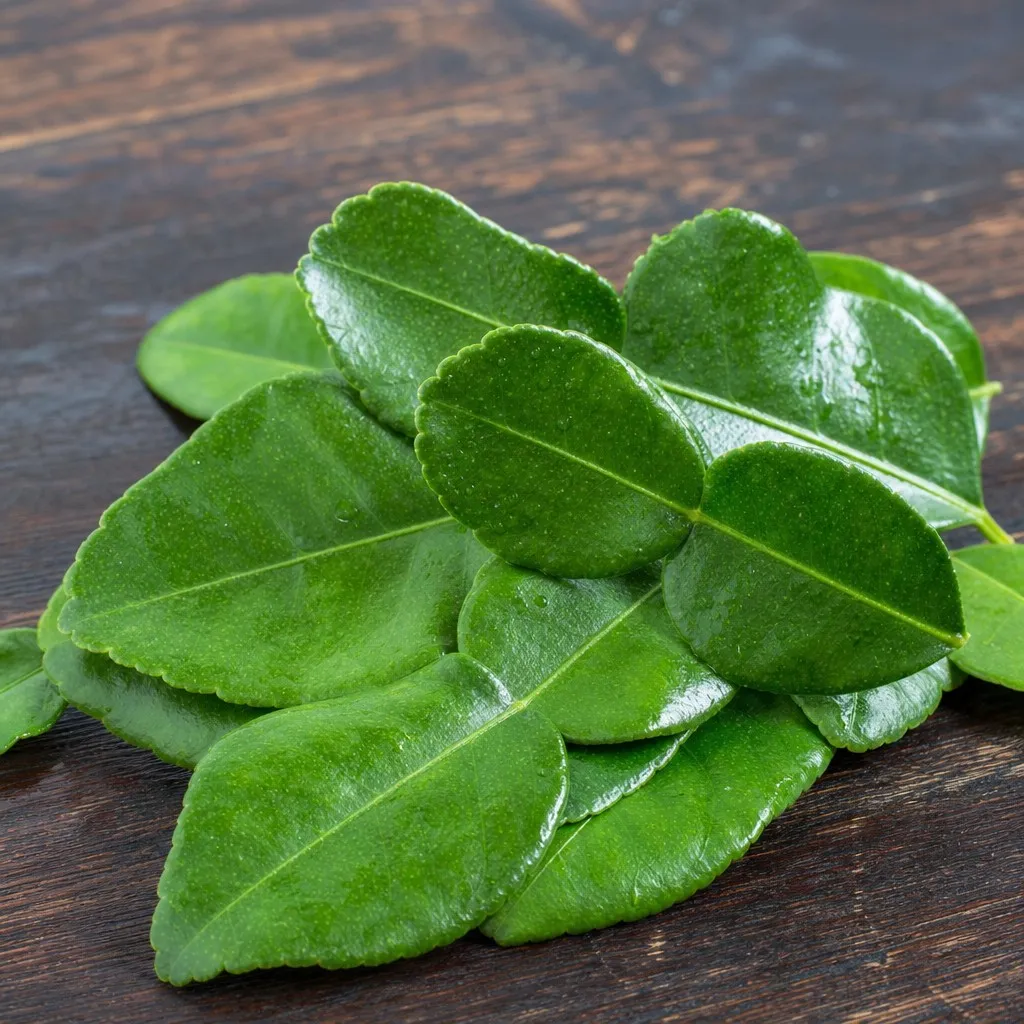
The most distinctive feature of kaffir lime leaves is their shape: two leaf segments joined end-to-end in a figure-8, with each segment attached to the next along a central stalk. No other common herb looks like this, so once you know what you are looking for, they are impossible to mistake. The leaves are dark, glossy green on top and lighter underneath. The lime fruit itself is equally distinctive: small, very bumpy and wrinkled, quite unlike a standard supermarket lime.
The leaves are one of the 20 most common ingredients in Thai food, and they appear across a huge range of dishes. Their role is primarily aromatic: they contribute fragrance and brightness in a way that nothing else quite replicates.
What do they taste like?
Intensely citrusy, floral, and almost perfume-like, but in a good way. The flavour is closer to lime zest than lime juice: there is no acidity, just the concentrated aromatic quality from the essential oils in the leaf. Underneath the citrus there is a slight bitterness and a herbal depth that lifts the whole profile.
Fresh kaffir lime leaves are one of those ingredients where the fragrance is just as important as the flavour. Even a small number of leaves (four or five) will perfume an entire pot of curry. When you bruise or shred them, the essential oils release immediately. That is the scent that signals to your nose that a dish is authentically Thai.
How kaffir lime leaves are used in Thai cooking
The leaves appear in two main ways: whole or bruised in soups and curries, or finely shredded as a garnish or in salads.
In soups (tom kha gai and tom yum are the most common), the leaves are added whole or lightly bruised and simmered in the broth. They are not eaten. Push them to the side of the bowl when you get to them, just as you would with a slice of galangal or a bruised stick of lemongrass. They have done their work by that point.
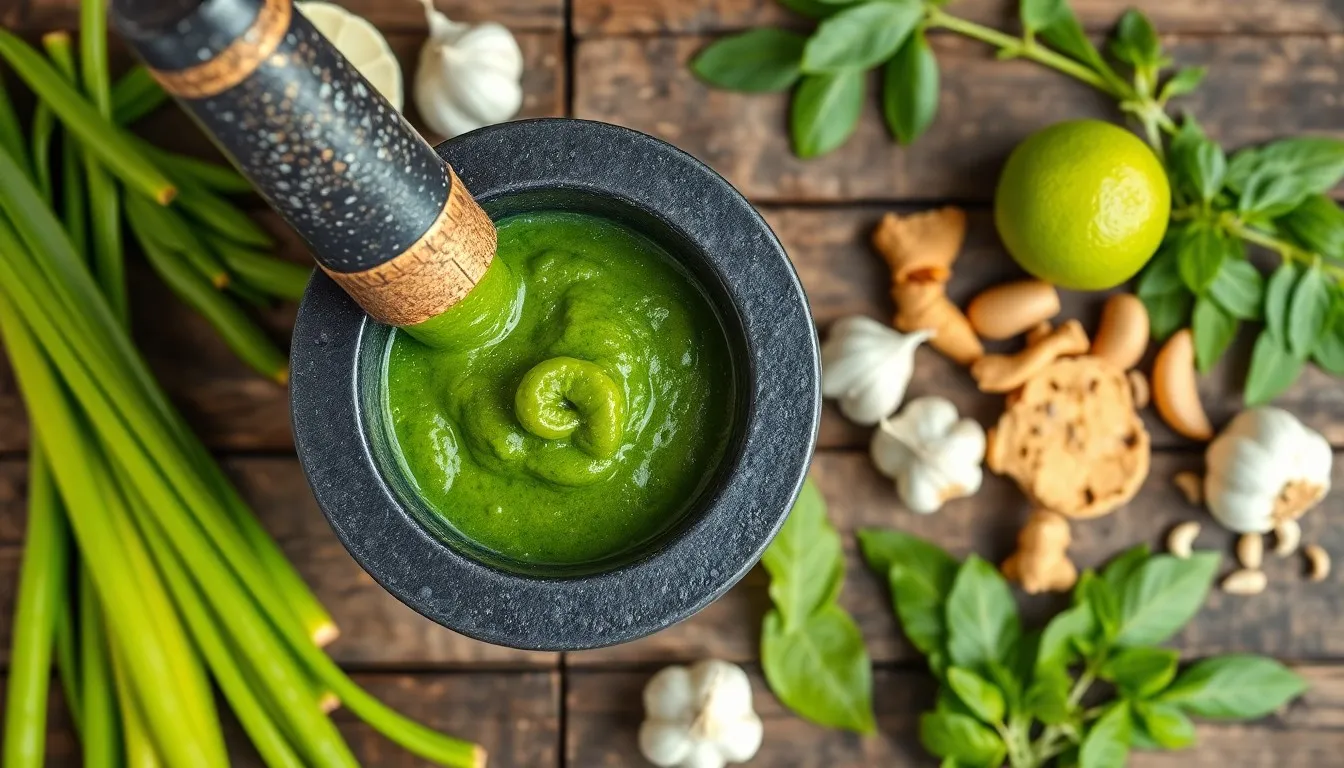
In curries, fresh leaves are often pounded directly into the paste. In a green curry paste, they give the paste its brightness and contribute to that distinctly Thai citrus note. A Thai green curry made without kaffir lime leaves tastes flat by comparison, one of those differences you notice immediately once you have eaten the real thing. In panang curry, three or four whole leaves are typically added to the sauce as it simmers.
Finely shredded leaves work well scattered over salads, used as a garnish on a finished curry, or stirred into certain rice dishes. See the preparation section below for how to shred them properly.
Fresh, frozen or dried: which is best?

Fresh or frozen, always. Dried kaffir lime leaves are a distant third and should only be used when nothing else is available.
| Feature | Fresh | Frozen | Dried |
|---|---|---|---|
| Aroma | Outstanding | Excellent | Weak |
| Flavour strength | Full | Very good | Significantly reduced |
| Convenience | Use immediately | Always to hand | Long shelf life |
| Recommended for | Shredded garnish, pastes | Soups, curries, pastes | Last resort only |
Freezing preserves the essential oils well. Frozen leaves can go straight into hot liquid from the freezer with no need to defrost. If you want to shred them, let them defrost for a few minutes at room temperature first. If you find a good source of fresh kaffir lime leaves, buy more than you need and freeze the rest in a sealed bag. They keep for six months or more and you will barely notice the difference in a cooked dish.
Dried leaves, available in the Asian or spice aisle at most large supermarkets, have lost most of the essential oils that make the fresh leaf powerful. Use three to four dried leaves for every one fresh leaf the recipe calls for. They are usable in long-simmered soups where there is time for whatever flavour remains to extract, but for curry paste they are not worth the effort.
Can't decide what to eat tonight?
Take our 60-second quiz and we'll pick for you
Where to buy kaffir lime leaves in the UK
The most reliable source is your nearest Asian supermarket: Wing Yip, New Loon Moon, Hong Kong Supermarket, or any local Thai or South-East Asian shop. These will almost always have fresh leaves, and often frozen too. If there is no Asian supermarket near you, Thai Food Online (thai-food-online.co.uk) and Sous Chef both stock fresh and frozen leaves for delivery.
Waitrose and M&S Simply Food occasionally stock fresh kaffir lime leaves in their fresh herb sections, but supply is erratic: one week they will have them; the next three they will not. Sainsbury's rarely carries them fresh. Most large Tesco, Sainsbury's, and Asda stores stock dried kaffir lime leaves in the Asian or herbs and spices aisle, which is useful as a fallback.
If you have outdoor space or a sunny windowsill, kaffir lime trees grow well in pots in the UK during summer and can be brought indoors in winter. A small tree will give you a continuous supply of fresh leaves. Specialist herb nurseries and online retailers sell young plants.
How to prepare kaffir lime leaves

For soups and curries where the leaf is added whole: drop them in as they are, or bruise each leaf lightly with the flat of a knife to help release the oils before adding to the pot.
For finely shredded leaves: fold each double leaf in half lengthways, then use your fingers to pull the central rib and stalk away from the leaf; it tears cleanly. Discard the rib. Stack two or three leaves together, roll them into a tight cylinder, then slice across into very thin threads. The thinner you cut them, the better the texture. These threads can be scattered over finished dishes or folded into salads.
For pounding into curry paste: tear or roughly chop the leaves first so they break down more easily in the mortar.
Kaffir lime leaf substitutes
There is no ingredient that genuinely replicates what kaffir lime leaves do. The aroma is too distinctive and too specific. In an emergency, the closest you can get is regular lime zest: use the zest of one lime for every four to six fresh leaves the recipe calls for. This gives citrus fragrance but none of the herbal depth or floral quality. Adding a small bay leaf alongside can provide some herbal structure, though the result will still taste noticeably different.
Kaffir lime juice, squeezed from the bumpy fruit itself if you can find it, is not the same as using the leaves. It adds citrus acidity rather than the aromatic oil quality of the leaf. If you do find the fruit, the zest of the skin is closer to the leaf than the juice.
Frequently asked questions
Should I say kaffir lime or makrut lime?
Both refer to the same ingredient. "Makrut" is the Thai name and is preferred by many cooks, while "kaffir" remains the term most commonly found on UK packaging and in shops. Both terms are used interchangeably in this guide and in most UK shops; you will not go wrong searching for either.
Can you eat kaffir lime leaves whole?
Not really. The leaves are too tough and the flavour too intense to eat whole. When added to soups and curries, push them to the side and leave them. Finely shredded leaves (with the central rib removed) can be eaten in small amounts in salads.
Can I substitute dried kaffir lime leaves for fresh?
Yes, but use 3–4 dried leaves for every fresh leaf called for, as dried leaves are much weaker. They work reasonably well in long-cooked dishes but lack the bright aroma of fresh or frozen.
Can you freeze kaffir lime leaves?
Yes, and freezing is highly recommended if you find a good source. Pop them into a freezer bag and freeze for up to 6 months. Drop them directly into hot soups and curries from frozen with no need to defrost first.



Comments