Written by Manaow Prasatthong, 3rd Generation Thai Chef
Pandan (known in Thai as ใบเตย, or bai toei) is a long, flat, bright green leaf that appears in Thai desserts, rice dishes, drinks, and even savoury food. Its scientific name is Pandanus amaryllifolius, and it is sometimes called screwpine. If you have eaten mango sticky rice and noticed the coconut cream had a subtle sweetness and fragrance beyond the obvious, pandan was almost certainly behind it. It is one of the 20 most common ingredients in Thai food, as familiar in a Thai kitchen as vanilla in a British bakery and equally hard to leave out.
What is pandan?
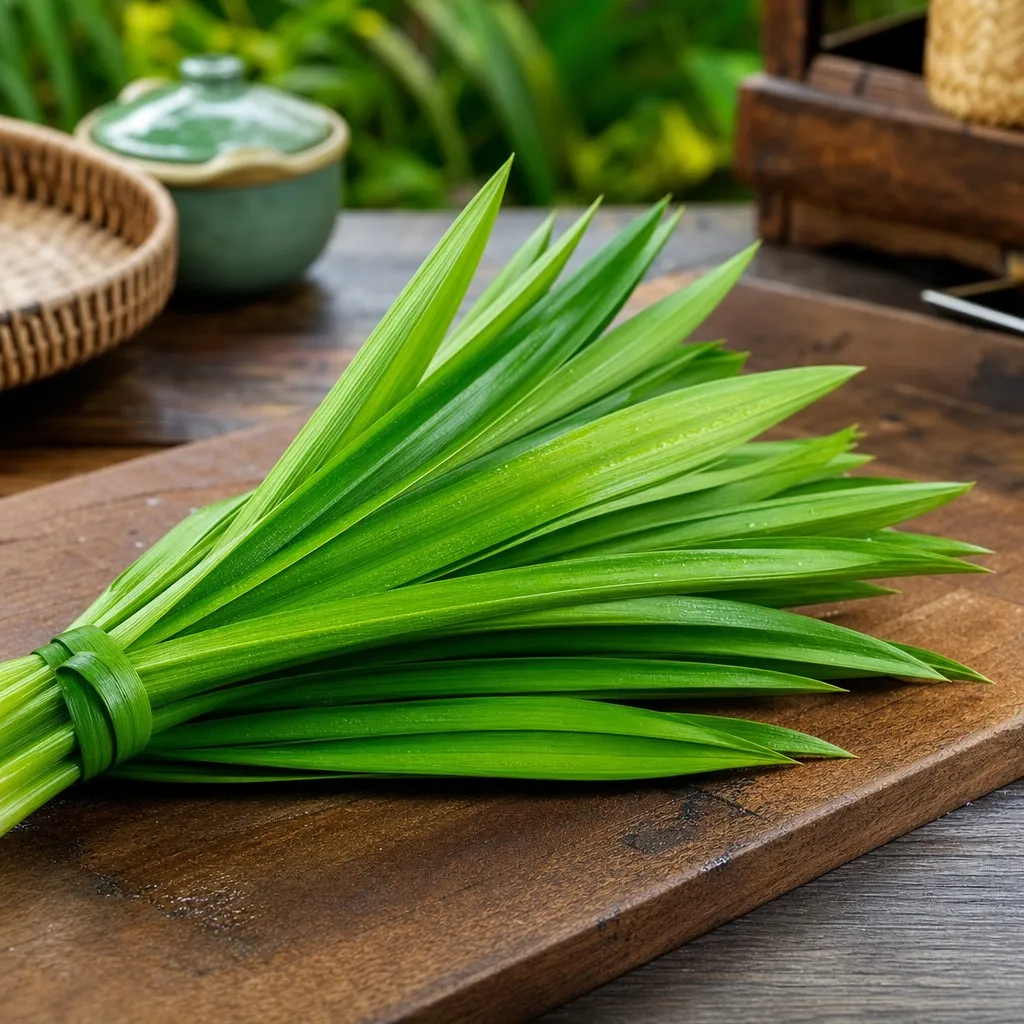
Pandan is a tropical plant whose leaves are harvested and used for their extraordinary fragrance. The leaves grow in fan-shaped clusters and reach 30–50cm in length: long, strap-like, and a vivid emerald green. They are smooth, waxy, and firm, with a distinct central ridge running along the underside. Unlike most fresh herbs, the leaves themselves are not eaten. They are used to infuse flavour into whatever they are cooked with, then removed or set aside.
In Thailand, pandan is used throughout the year and grows in home gardens as readily as mint grows in British back gardens. The plant thrives in tropical climates, which is part of why it became so deeply embedded in South-East Asian cooking, and why it is something of a luxury to source in the UK. The leaves can reach 12–20 inches in length and are usually sold either fresh or frozen, with the frozen version being far easier to find outside of London.
What does pandan taste like?
The flavour is genuinely difficult to describe, which is why "the vanilla of Asia" is the comparison that sticks: it captures the idea of a background sweetness and floral warmth that lifts everything around it. But pandan is its own thing entirely. The aroma carries notes of freshly cut grass, steamed jasmine rice, rose, almond, and a faint hint of coconut. It is sweet without sugar, floral without being perfumed, and slightly nutty at the back of the palate.
When you knot a pandan leaf and add it to a pot of cooking rice, the whole kitchen smells different within minutes. That fragrance transfers into the rice and lingers. In desserts, pandan provides the same function vanilla does in Western baking: not the main flavour, but the thing that makes everything else taste more complete. The vivid green colour is another distinctive quality: pandan extract tints whatever it touches a soft, natural green, which is why green desserts and drinks across South-East Asia often get their colour from pandan rather than artificial food colouring.
How is pandan used in Thai cooking?

The most famous use is mango sticky rice (khao niao mamuang). The sticky rice is cooked with a knotted pandan leaf in the steaming water, which infuses it with fragrance throughout the cooking process. The coconut cream sauce is also often warmed with pandan before being poured over the rice. It is a simple technique, but the difference between pandan-infused sticky rice and plain sticky rice is immediately noticeable (see the full method in the sticky rice guide, or our mango sticky rice without a steamer guide for a simpler approach).
Pandan chicken (kai ho bai toei) is a savoury application where marinated pieces of chicken thigh are individually wrapped in pandan leaves and deep-fried. The leaf seals in moisture, chars slightly at the edges, and imparts its fragrance directly into the meat. The wrapper is discarded before eating; it is a flavour vehicle, not part of the dish itself.
Can't decide what to eat tonight?
Take our 60-second quiz and we'll pick for you
Beyond those two signature dishes, pandan is used to:
- Infuse coconut milk for desserts and puddings (add two or three knotted leaves while warming the coconut milk, then remove before using)
- Flavour jasmine rice while cooking: knot one or two leaves and add to the pot with the water; remove before serving
- Colour and flavour pandan juice and iced drinks
- Make pandan-flavoured layer cakes (khanom chan), jellies, and custards
- Add fragrance to coconut-based curries in some regional Thai recipes
Where to buy pandan in the UK

Frozen pandan leaves are the most accessible option for most UK cooks, and they work well. You will find them in the freezer section of Asian supermarkets; any shop with a decent Thai or South-East Asian range should stock them. The freezing process does not significantly damage the flavour or fragrance, and frozen leaves can be used directly in cooking without defrosting first.
Fresh pandan leaves are available at larger Asian supermarkets, particularly in London and other major cities with established South-East Asian communities. If you are in or near London, look in Chinese and Thai supermarkets in Chinatown, Brixton, or areas with a large Vietnamese or Thai population. Fresh leaves have a slightly brighter fragrance than frozen, but the difference is subtle in most cooked dishes.
Pandan extract and essence (small bottles of concentrated liquid) are widely available online and in Asian grocery stores. Bake With Yen is one of the most commonly found brands in the UK. The extract is particularly useful for baking, drinks, and desserts where you want both the flavour and the natural green colour. Some Waitrose stores and Ocado also stock pandan extract, typically in the world foods or baking aisle, and it is worth checking their websites if no Asian supermarket is nearby.
Pandan substitutes
There is no true substitute for pandan; its flavour is distinctive enough that nothing else fully replicates it. That said, here are the practical options when you cannot source it:
| Substitute | Best used for | Notes |
|---|---|---|
| Pandan extract / essence | Desserts, drinks, rice | Most practical substitute; start with 3–4 drops per recipe, taste before adding more |
| Vanilla extract | Desserts only | Shares the sweet, floral warmth but lacks pandan's grassy character; use ½ tsp per leaf as a rough guide |
| Omit entirely | Savoury dishes | In curries or chicken dishes, leaving pandan out is better than a poor substitute that pulls the flavour in the wrong direction |
For rice dishes, a few drops of pandan extract stirred into the cooking water is a workable alternative. The fragrance will not be as pronounced as fresh leaves, but it will be there. For mango sticky rice specifically, pandan extract in both the rice water and the coconut cream sauce gives a noticeably better result than omitting it entirely.
Pandan is not an ingredient you can quietly leave out and hope nobody notices. It is the fragrance that makes certain Thai dishes immediately recognisable. If you cook Thai desserts at all, keeping a bag of frozen leaves in the freezer and a bottle of extract in the cupboard covers almost every situation. Both are inexpensive, both keep well, and both make a real difference. The lemongrass, galangal, and kaffir lime leaves get more attention as Thai aromatics, but pandan is the one that makes the sweet side of Thai cooking unforgettable.
Frequently asked questions
Is pandan the same as vanilla?
No, but the flavour has a similar sweet, floral warmth. Pandan has a grassier, more herbal quality and a distinctive green colour. In South-East Asian cooking, pandan plays the role vanilla plays in Western baking: background sweetness and fragrance rather than the main flavour. The two are not interchangeable in most recipes, though vanilla is the closest flavour substitute in desserts when pandan is unavailable.
Can I use pandan extract instead of fresh leaves?
Yes, pandan extract or essence works well in desserts and drinks. For infusing rice or coconut milk, fresh or frozen leaves are preferable as they give more aroma and a more rounded flavour. If using extract, start with 3–4 drops and taste before adding more, as it is concentrated and too much gives a slightly artificial edge. For baking and desserts where you also want the green colour, extract is actually more convenient than fresh leaves.
Where can I buy pandan leaves in the UK?
Frozen pandan leaves are widely available in Asian supermarkets. Fresh leaves can be found at larger Asian supermarkets, particularly in London. Pandan extract is available at most Asian grocery stores, online, and occasionally at Waitrose and via Ocado. If no Asian supermarket is nearby, ordering frozen leaves from a Thai grocery website is the most reliable option.
Do you eat pandan leaves?
Not typically. The leaves are used to infuse flavour into dishes and then removed or discarded, as they are too fibrous and intensely flavoured to eat directly. The exception is dishes like pandan chicken (kai ho bai toei) where the leaf is used as a cooking wrapper, but even then the wrapper is removed before eating. Think of a pandan leaf the way you would a bay leaf: essential for flavour, not on the plate at the end.




Comments