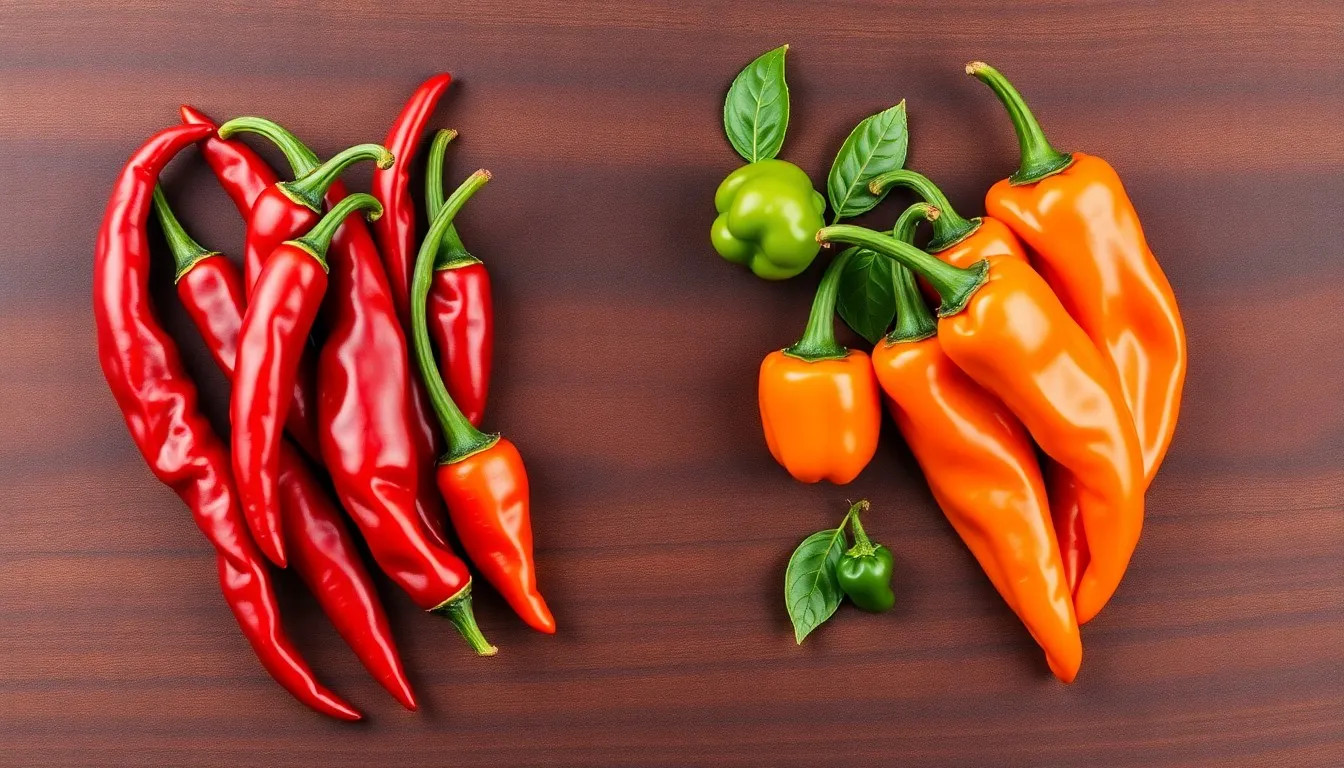
Thai chilli peppers and habanero peppers are both known for their spiciness and are used in various cuisines worldwide. However, they have distinct differences in terms of appearance, flavour, heat level, and culinary uses. Even though they are both chillies, they are very different. With that being said, let’s do a comparison, Thai chilli vs Habanero. You might also be wondering is Thai food spicy in general, or how it compares — see my article on whether Thai food is spicier than Indian food.
1. Appearance:
Thai Chilli (Bird’s Eye Chilli): Thai chillies are small, slender, and typically about 1-2 inches (2.5-5 cm) in length. They are usually bright red or green when ripe, and they have a thin, pointed shape.
Habanero: Habanero peppers are slightly larger, typically 1-2.5 inches (2.5-6.5 cm) long, and they have a distinctive lantern-like shape. They can vary in colour from green to orange, red, or even brown.

2. Flavour:
Thai Chilli: Thai chillies are known for their sharp, intense heat with a clean, crisp flavour. They provide a quick, fiery kick and are often described as having a slightly grassy or citrusy undertone.
Habanero: Habaneros have a fruity and floral flavour with a more pronounced sweetness compared to Thai chillies. Their heat tends to linger, providing a complex spiciness with a hint of tropical fruitiness.
3. Heat Level:
Thai Chilli: Thai chillies are hot, typically ranging from 50,000 to 100,000 Scoville Heat Units (SHU). However, they can sometimes reach even higher levels on the Scoville scale, making them quite fiery.
Habanero: Habanero peppers are among the hottest chilli peppers globally, with a range of 100,000 to 350,000 SHU. Some varieties can even surpass 350,000 SHU, making them significantly hotter than most Thai chillies.
Here’s the full Scoville Heat Scale, which measures the spiciness of chilli peppers from mildest to hottest. I’ve highlighted the two peppers this guide is all about so you can see exactly where they sit — and just how much hotter a habanero is than a Thai chilli:
| Pepper/Variety | Scoville Heat Units (SHU) |
|---|---|
| Bell Pepper | 0 |
| Pimento Pepper | 100–500 |
| Banana Pepper | 0–500 |
| Anaheim Pepper | 500–2,500 |
| Poblano Pepper | 1,000–2,000 |
| Jalapeño Pepper | 2,500–8,000 |
| Chipotle Pepper | 2,500–8,000 |
| Serrano Pepper | 10,000–23,000 |
| Cayenne Pepper | 30,000–50,000 |
| Tabasco Pepper | 30,000–50,000 |
| 🌶️ Thai Chilli (Bird’s Eye) | 50,000–100,000 |
| 🔥 Habanero Pepper | 100,000–350,000 |
| Scotch Bonnet Pepper | 100,000–350,000 |
| Ghost Pepper (Bhut Jolokia) | 855,000–1,041,427 |
| Carolina Reaper | 1,641,183–2,200,000 |
Please note that these heat ranges can vary depending on factors such as growing conditions and individual pepper variations. The Scoville Heat Scale provides a general idea of the spiciness of chilli peppers, with higher SHU values indicating hotter peppers.
4. Culinary Uses:
Thai chilli and habanero FAQ
Is a habanero hotter than a Thai chilli?
Yes. Habanero peppers measure 100,000–350,000 Scoville Heat Units (SHU), while Thai bird's eye chillies measure 50,000–100,000 SHU. Habaneros are typically 3–7 times hotter than Thai chillies.
What is the Scoville rating of a Thai chilli?
Thai bird's eye chillies range from 50,000 to 100,000 Scoville Heat Units (SHU). Some varieties can exceed 100,000 SHU depending on growing conditions.
Can I substitute habanero for Thai chilli?
You can use habanero instead of Thai chilli, but use a much smaller amount — habaneros are 3–7x hotter and have a distinct fruity, floral flavour that will change the dish. For authentic Thai recipes, bird's eye chillies are strongly preferred.
What is the difference in flavour between Thai chilli and habanero?
Thai bird's eye chillies have a sharp, clean heat with a slightly grassy or citrusy undertone. Habaneros have a fruity, floral sweetness alongside their intense heat — they taste quite different even at the same heat level.
What can I use instead of Thai chilli?
Serrano peppers are the best widely available substitute for Thai bird's eye chillies — they share a sharp, clean heat, though they are only a third to a half as hot, so use about twice as many. Avoid habaneros, which are hotter and add a fruity flavour that does not suit Thai food.
Is a Thai chilli hotter than a jalapeño?
Yes, far hotter. A Thai bird's eye chilli measures 50,000–100,000 SHU, while a jalapeño measures just 2,500–8,000 SHU — making a Thai chilli roughly 10 to 20 times hotter.
Thai Chilli: Thai chillies are a staple in Thai cuisine, where they are used to add spiciness and flavour to dishes like curries, stir-fries, soups (such as Tom Yum), and salads (like Som Tum). They are often used whole, sliced, or pounded into pastes.

Habanero: Habanero peppers are popular in Latin American and Caribbean cuisines. They are used in hot sauces, salsas, and marinades, and as a way to add intense heat to dishes. Habaneros are also employed in some international dishes that require extreme spiciness.
Is Bird’s Eye Chilli the Same as Thai Chilli?
Yes — for cooking purposes they’re the same pepper. “Thai chilli” is simply the common English name, while “bird’s eye chilli” describes the small, pointed pods that grow upright on the plant like a bird’s beak. In Thailand we call them prik kee noo, which translates rather unglamorously as “mouse-dropping chilli” — a nod to their tiny size, not their flavour. So when a recipe asks for Thai chillies, reach for bird’s eye chillies and you’ll have exactly the right thing: 50,000–100,000 SHU of clean, sharp heat.
Can't decide what to eat tonight?
Take our 60-second quiz and we'll pick for you
How Thai Chillies Compare to Serrano, Jalapeño and Other Peppers
Habanero isn’t the only pepper people line up against a Thai chilli. Here’s how the bird’s eye stacks up against the peppers you’re most likely to find in a UK supermarket, from mildest to hottest:

- Thai chilli vs jalapeño: A Thai chilli is roughly 10–20× hotter than a jalapeño (2,500–8,000 SHU). Jalapeños give a mild, grassy warmth — pleasant, but you’d need a fistful to match a single bird’s eye.
- Thai chilli vs serrano: Serranos (10,000–23,000 SHU) are my pick for the best supermarket substitute. They’re sharper and cleaner than a jalapeño and closer in character to a Thai chilli, even though they’re only a third to a half as hot.
- Thai chilli vs cayenne: Fresh cayenne (30,000–50,000 SHU) gets within range on heat, but it’s usually sold dried and ground, so it loses the fresh, juicy bite of a whole bird’s eye.
- Thai chilli vs scotch bonnet: Like the habanero, a scotch bonnet (100,000–350,000 SHU) is hotter than a Thai chilli and carries a fruity, tropical sweetness that belongs in Caribbean cooking — not a Thai stir-fry.
- Thai chilli vs chile de árbol: Chile de árbol (15,000–30,000 SHU) is a handy dried option with a similar slim shape, but it’s milder and a touch smoky.
What Does a Thai Chilli Taste Like?
People assume a Thai chilli tastes of nothing but fire, but there’s more going on. The heat arrives fast and sharp, then fades cleanly — there’s none of the slow, lingering burn you get from a habanero. Underneath the heat sits a bright, slightly grassy, almost citrusy note, and that’s exactly why bird’s eye chillies pair so naturally with lime, lemongrass and fish sauce. That clean profile is what lets them bring serious heat to Tom Yum soup or a plate of Pad Krapow without ever muddying the other flavours.
Can You Substitute Habanero for Thai Chilli in Cooking?
This is the question I get asked most often — and the honest answer is: sometimes, but usually you shouldn't.
When it works: If a dish just needs heat and the chilli isn't a starring ingredient — a marinade, a hot sauce, a dipping sauce — a small amount of habanero can stand in. Use about one-third the amount you'd use of Thai bird's eye chillies to account for the extra heat.
When it doesn't work: In almost every authentic Thai recipe, the bird's eye chilli is there for both heat and flavour. The clean, sharp bite of a Thai chilli is what makes Pad Krapow taste right. Swap it for habanero and you introduce a fruity, floral sweetness that simply doesn't belong. Green curry paste is the same — the green chillies aren't just for spice, they define the flavour profile.
My advice as a Thai chef: If you can't find Thai bird's eye chillies, use serrano peppers as a substitute before reaching for habanero. Serranos are closer in flavour profile — sharp and clean — even though they're milder (10,000–23,000 SHU). Double the amount and you'll get closer to the right taste than using a single habanero.
1 Thai bird's eye chilli ≈ ⅓ habanero (heat only — flavour will differ)
1 Thai bird's eye chilli ≈ 2 serrano peppers (better flavour match)

TLDR; Habanero vs Thai Chilli
While both Thai chillies and habaneros are known for their heat, they have distinct flavours, appearances, and culinary uses. Thai bird's eye chillies are favoured for their intense, clean spiciness in Thai dishes — they're the key ingredient in Thai green curry paste and are what gives green curry its heat. Habaneros bring a unique fruity and floral flavour alongside their more intense heat, making them popular in Latin American and Caribbean cuisines. The choice between them depends on the specific flavour profile and spiciness level desired in a particular dish.



Comments